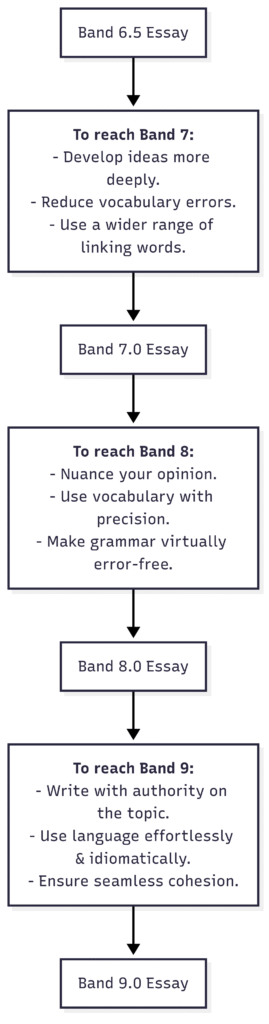
Get 4 unique sample answers (Band 6.5, 7, 8, and 9) for a common Task 2 topic, with a detailed examiner’s analysis of vocabulary, structure, and argumentation.
Topic: In many urban areas, loneliness and social isolation are becoming more common. What are the causes of this trend, and what solutions can be implemented?
Band 6.5 Essay
Nowadays, in many big cities around the world, a lot of people are feeling lonely and isolated. This is a big problem for society and for the health of individuals. This essay will talk about the main reasons for this issue and suggest some ways to solve it.
There are two main causes of this problem. The first one is the fast pace of life in cities. People are very busy with their jobs and commuting long distances, so they have less free time to meet friends or talk to their neighbours. For example, after a long day at work and a stressful journey home, most people just want to relax alone instead of socializing. The second cause is technology. Even though smartphones and social media are meant to connect us, they often make us more alone. People spend hours looking at screens instead of talking to the person next to them. This can make online connections feel shallow and replace deeper, real-life friendships.
However, there are some solutions that can help. One way is for city governments to create more community spaces. If there are more parks, libraries, and community centres, people will have places to meet and interact without spending money. Another solution is for people themselves to try and join clubs or groups based on their hobbies. This could be a sports team, a book club, or a cooking class. When people share an interest, it is easier to start a conversation and make new friends. This can help to fight feelings of loneliness.
In conclusion, loneliness in cities is mainly caused by busy lifestyles and technology. But by building better community facilities and encouraging people to join social groups, we can help to reduce social isolation and make urban areas more friendly places to live.
(Word count: 277)
Band 7.0 Essay
The increasing prevalence of loneliness and social isolation in urban environments is a pressing social issue with significant implications for public health. This trend is primarily driven by the nature of modern urban life and technological shifts, but it can be mitigated through concerted efforts by both communities and city planners.
Two fundamental causes are paramount. Firstly, the demanding structure of city life leaves little room for social interaction. Long working hours, coupled with exhausting commutes, deplete individuals’ energy and time, making it easier to retreat into solitude than to actively maintain a social circle. Consequently, superficial relationships with colleagues often replace meaningful bonds with family and friends. Secondly, while digital technology promises connection, it frequently fosters isolation. Social media platforms encourage comparison and curated online personas, which can exacerbate feelings of inadequacy and reduce the motivation for face-to-face contact, which is essential for deep emotional connection.
Addressing this issue requires a multi-faceted approach. A key solution is for municipal authorities to prioritize the development of inclusive public infrastructure. This involves not only creating more green spaces and pedestrian zones but also funding community centers that host workshops, social events, and support groups, thereby providing natural opportunities for interaction. Furthermore, the onus is also on employers to promote a healthier work-life balance. Initiatives such as flexible working hours or remote work options can give employees back precious time, which they can then invest in nurturing local relationships and engaging in their communities.
In conclusion, urban loneliness stems from hectic lifestyles and the paradoxical effects of technology. By investing in social infrastructure and reforming work cultures, societies can take significant strides towards reintegrating isolated individuals and fostering a greater sense of community belonging.
(Word count: 275)
Band 8.0 Essay
The paradox of urban loneliness—feeling alone in a crowd—is an escalating crisis in metropolitan hubs worldwide. This phenomenon, ironically fuelled by the very factors that make cities attractive, namely economic opportunity and technological connectivity, necessitates a systematic examination of its root causes and a proactive implementation of targeted solutions.
The etiology of this trend is multifaceted. A primary catalyst is the erosion of traditional community structures. Urban dwellers often live transient lives, frequently moving for career advancement, which disrupts the formation of long-term, stable neighbourhood bonds. This atomized existence is compounded by an economic paradigm that prioritizes productivity and efficiency, leading to a culture of chronic busyness that frames socializing as an unaffordable luxury rather than a necessity. Moreover, the digital revolution has fundamentally altered social dynamics. While purporting to connect us, online interactions often serve as a simulacrum for genuine community, satisfying the need for connection superficially but leaving deeper psychological needs for belonging and shared physical experience unfulfilled.
Tackling this complex issue demands innovative and collaborative solutions. Urban design must be reimagined through a sociological lens, moving beyond mere functionality to actively encourage serendipitous interaction. This can be achieved through tactical urbanism, such as creating mixed-use developments, pedestrian-friendly streetscapes, and accessible green spaces that naturally bring people together. Simultaneously, a cultural shift is required to elevate the value of community engagement. Local governments and NGOs can spearhead this by sponsoring street festivals, cultural events, and volunteer programs that bridge socio-economic divides and create shared identity. Ultimately, combating isolation requires designing cities for people, not just for commerce and traffic.
In conclusion, urban isolation is a symptom of modern societal structures and technological change. Effective solutions must therefore be equally systemic, involving intentional urban planning and community-building initiatives that consciously weave the social fabric back together.
(Word count: 298)
Band 9.0 Essay
The ascendancy of loneliness as a defining feature of urban existence presents a profound contradiction of the modern age. Despite unparalleled population density and digital interconnectedness, a sense of deep social isolation is pervasive. This malaise is not merely a personal issue but a societal one, rooted in the architectural, economic, and technological fabric of contemporary cities, and its remedy lies in a fundamental revaluation of what constitutes a thriving community.
The causes are deeply entrenched and synergistic. Architecturally, many modern cities are designed for efficiency and commerce, not for human interaction. Urban sprawl and car-centric planning create physical and psychological distance, while the proliferation of high-rise apartments and the decline of third places—those public spaces distinct from home and work—erode the venues for spontaneous community formation. Economically, the premium placed on hyper-mobility and career specialization fosters anonymity and transience, discouraging investment in local relationships. This is exacerbated by a consumer culture that individualism, often at the expense of collective well-being. Technologically, the digital sphere has become a double-edged sword; it provides the illusion of connection while enabling a retreat from the messy, demanding nature of authentic human relationships, allowing citizens to curate their social lives to the point of abstraction.
Solutions, therefore, must be equally holistic and ambitious. Firstly, urban planning must adopt a human-centred approach informed by disciplines like environmental psychology. This involves prioritising walkable neighbourhoods, investing in vibrant, well-maintained public plazas, and mandating inclusive design in new developments to create natural congregation points. Secondly, policy interventions are crucial. Governments can incentivize community-building by funding local arts programs, supporting grassroots initiatives, and designing public health campaigns that frame social connection as a key determinant of health, akin to diet and exercise. Finally, a cultural reckoning is needed to challenge the hegemony of busyness and digital engagement, promoting instead the values of presence, mutual aid, and embodied connection.
In summary, urban loneliness is a complex outcome of structural and cultural forces. Mitigating it requires a paradigm shift—from designing cities as engines of capital to cultivating them as ecosystems of belonging, where policy and design are consciously harnessed to foster the human connections essential for collective flourishing.
(Word count: 343)
| IELTS Marking Criteria | Band 6.5 | Band 7.0 | Band 8.0 | Band 9.0 |
|---|---|---|---|---|
| Task Response | Addresses all parts but develops ideas generally. Position is clear but simplistic. | Clear, relevant position. Ideas are extended and supported (may be predictable). | Addresses all parts skillfully. Develops well-reasoned, nuanced ideas. | Fully addresses all parts with authority, depth, and precision. |
| Coherence & Cohesion | Information is organized logically. Uses basic linking words effectively. | Logical progression throughout. Uses a range of cohesive devices appropriately. | Manages cohesion skillfully. Links ideas seamlessly. Paragraphing is effective and logical. | Uses cohesion effortlessly. Progression is intuitive and sophisticated. |
| Lexical Resource | Adequate range of vocabulary. Some errors in word choice or collocation. | Sufficient range of less common words. Some style awareness, minor errors. | Wide, fluent, flexible vocabulary. Precise word choice & collocation. | Sophisticated, natural, idiomatic control. Flawless precision. |
| Grammatical Range & Accuracy | Mix of simple & complex sentences. Some errors that don’t impede meaning. | Variety of complex structures. Many error-free sentences. | Wide range of structures with full flexibility. Virtually error-free. | Full range of structures used naturally and accurately. Consistently error-free. |
Analysis of Key Differences Between Band Scores
The progression from Band 6.5 to Band 9 is marked by increasing sophistication in Task Response, Coherence and Cohesion, Lexical Resource, and Grammatical Range and Accuracy.
1. Task Response (Addressing the prompt)
- Band 6.5: Addresses all parts of the prompt (causes, solutions) but the ideas are general and somewhat undeveloped. The causes (“busy life”, “technology”) and solutions (“build parks”, “join clubs”) are predictable and lack specific detail.
- Band 7.0: Presents clear, relevant ideas that are extended and supported. The causes are more specific (“exhausting commutes”, “curated online personas”) and the solutions are more developed (“pedestrian zones”, “flexible working hours”).
- Band 8.0: Sufficiently addresses all parts of the prompt with well-developed, extended, and supported ideas. It explores the paradox of cities and introduces more sophisticated concepts like the “erosion of traditional community structures” and “tactical urbanism.”
- Band 9.0: Fully addresses all parts of the prompt with fully extended and well-supported ideas. The response is authoritative and insightful, exploring the depth and complexity of the issue (“architectural, economic, and technological fabric”). The solutions are holistic and ambitious (“paradigm shift”, “ecosystems of belonging”).
2. Coherence and Cohesion (Structure and Flow)
- Band 6.5: Information is organized coherently with clear paragraphs and basic linking words (first, second, in conclusion). The structure is logical but mechanical.
- Band 7.0: Logically organizes information and ideas; there is a clear progression throughout. Uses a range of cohesive devices (consequently, furthermore, thereby) appropriately.
- Band 8.0: Manages all aspects of cohesion skillfully. Uses a wide range of cohesive devices flexibly (this atomized existence is compounded by, simultaneously, ultimately) to create a seamless flow of ideas.
- Band 9.0: Uses cohesion in such a way that it attracts no attention. The essay flows effortlessly from one sophisticated idea to the next. The relationship between ideas is precise and logical (This is exacerbated by, Solutions, therefore, must be…).
3. Lexical Resource (Vocabulary)
- Band 6.5: Uses an adequate range of vocabulary for the task. Attempts less common lexis (pace of life, shallow) but with some repetition and a lack of style (“big problem”, “main reasons”).
- Band 7.0: Uses a sufficient range of vocabulary to allow flexibility and precision. Uses less common lexical items (prevalence, pressing issue, mitigated, multifaceted) with some awareness of style and collocation.
- Band 8.0: Uses a wide range of vocabulary fluently and flexibly to convey precise meanings. Uses sophisticated lexical items skillfully (paradox, etiology, atomized existence, simulacrum, tactical urbanism).
- Band 9.0: Uses a wide range of vocabulary with very natural and sophisticated control of lexical features. Uses rare, idiomatic, and precise vocabulary with flawless accuracy (ascendancy, malaise, synergistic, hegemony, reckoning, embodied connection).
4. Grammatical Range and Accuracy
- Band 6.5: Uses a mix of simple and complex sentence forms. Makes some errors (“a lot of people are feeling”, “less free time to meet”) but they do not impede communication.
- Band 7.0: Uses a variety of complex structures (e.g., “While purporting to connect us…”). Produces frequent error-free sentences. Has good control of grammar and punctuation.
- Band 8.0: Uses a wide range of structures with full flexibility and accuracy. The majority of sentences are error-free. Punctuation is skilfully and accurately used to manage complex sentences.
- Band 9.0: Uses a full range of structures naturally and appropriately. Consistently produces accurate, error-free sentences. Grammar is used to create sophisticated nuances of meaning and to control the argument’s pace and focus (e.g., the use of em-dashes and semicolons for added explanation).
In summary, the journey from a 6.5 to a 9 is a shift from general to precise, from functional to sophisticated, from adequately organized to skilfully seamless, and from occasionally inaccurate to consistently flawless.