
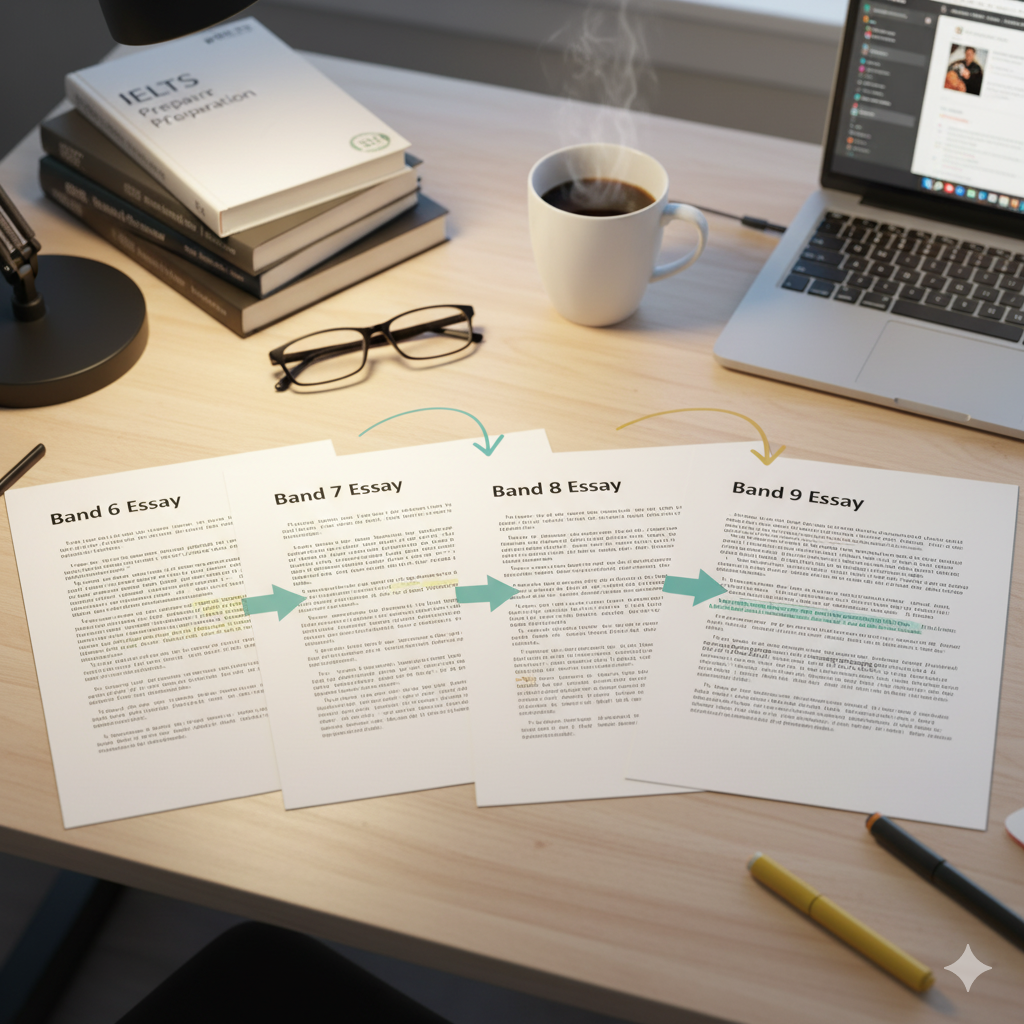
🧩 Essay Type 1: Opinion Essay (Agree or Disagree)
Topic: Online Learning vs. Traditional Learning
Question:
Some people believe that online learning is better than traditional classroom learning.
To what extent do you agree or disagree?
🎯 Understanding the Progression
Each higher band essay improves in four main areas:
- Thesis clarity and focus
- Logical paragraphing
- Development and coherence
- Lexical and grammatical range
Let’s see this in action 👇
🎓 Band 6.0 Version
Introduction:
Nowadays, online education has become popular among students. Some people think it is better than going to school. I agree that online learning is good, but it also has some problems.
Body Paragraph 1:
Online education is better because students can learn from home. They can study at any time. It is also cheaper because they do not need to travel. For example, many students in my country take online courses because they save money and time.
Body Paragraph 2:
However, traditional classrooms are important because students can meet teachers and friends. They can ask questions face to face and learn teamwork. Sometimes online classes are boring and make students lazy.
Conclusion:
In conclusion, I think online learning is good because it saves money and time, but schools are still important for communication.
🩵 Commentary:
- [Explanation: Thesis is vague — “good but also has some problems” doesn’t show a clear stance.]
- [Comment: Ideas are relevant but simple and repetitive.]
- [Comment: Linking words are basic (“because,” “and,” “but”).]
- [Comment: Paragraphs are short with limited development.]
- Estimated Band: 6.0 (Limited range, partial development, clear but weak opinion).
🎓 Band 7.0 Version
Introduction:
Online education has become increasingly common in recent years. Although some people prefer traditional classrooms, I believe online learning provides greater convenience and flexibility for most students.
Body Paragraph 1:
One advantage of online learning is flexibility. Students can study whenever and wherever they want, which helps those who work or live far from universities. For instance, many professionals now take evening online courses to improve their skills without leaving their jobs.
Body Paragraph 2:
However, studying online can reduce interaction with teachers and classmates. In physical classrooms, students can immediately ask questions and share ideas, which promotes deeper understanding. Despite this, the benefits of accessibility and time management outweigh these drawbacks.
Conclusion:
In conclusion, while traditional classrooms encourage social interaction, online education offers flexibility that better suits the modern lifestyle.
💙 Commentary:
- [Explanation: Clear opinion stated and maintained — “I believe online learning provides greater convenience…”]
- [Comment: Each paragraph has a clear topic sentence and explanation.]
- [Comment: Linking is smoother (“Although…”, “Despite this…”).]
- [Comment: Some minor repetition and limited vocabulary range.]
- Estimated Band: 7.0 (Coherent and relevant but lacks advanced cohesion and depth).
🎓 Band 8.0 Version
Introduction:
In today’s digital era, virtual education has become a powerful alternative to classroom-based learning. I strongly agree that online learning is more beneficial as it offers unmatched flexibility and equal access to education for all learners.
Body Paragraph 1:
The greatest strength of online education lies in its flexibility. Students can attend classes at their convenience, which allows them to balance studies with personal and professional responsibilities. For example, working adults can earn degrees without quitting their jobs, an option unavailable in traditional systems. This flexibility fosters lifelong learning.
Body Paragraph 2:
Another significant advantage is accessibility. Learners from remote or underprivileged regions can now access world-class universities and instructors online. This not only democratizes education but also helps bridge the global knowledge gap. Hence, online learning enhances equality in education, a value traditional systems often fail to achieve.
Conclusion:
Overall, the flexibility and accessibility of online education make it a superior mode of learning in today’s interconnected world.
💜 Commentary:
- [Explanation: Thesis is strong, clear, and specific (“more beneficial as it offers unmatched flexibility and equal access…”).]
- [Comment: Paragraphs are well developed — each has one clear idea with strong example.]
- [Comment: Variety in connectors (“hence,” “not only…but also…”).]
- [Comment: Vocabulary is academic and precise (“democratizes,” “fosters,” “interconnected world”).]
- Estimated Band: 8.0 (Well-developed, coherent, advanced vocabulary, minor room for more sophistication).
🎓 Band 9.0 Version
Introduction:
Online learning has revolutionized modern education by breaking geographical and temporal barriers. I completely agree that it surpasses traditional classroom learning because it promotes self-directed study and widens educational access globally.
Body Paragraph 1:
Firstly, online education nurtures self-discipline and independent learning skills. Unlike fixed classroom schedules, virtual platforms require learners to manage their own time and set personal goals. This autonomy mirrors real-world professional environments, where self-management is essential. For instance, individuals who complete online degrees often demonstrate superior time-management abilities compared to conventional students.
Body Paragraph 2:
Secondly, online learning broadens educational opportunities across borders. Students from developing nations can now enroll in Ivy League courses without relocation costs. This inclusivity not only enhances global knowledge exchange but also promotes cultural understanding among diverse learners. Consequently, online learning is not just a convenience but a catalyst for global academic collaboration.
Conclusion:
In summary, by fostering self-discipline and enabling global accessibility, online education represents the evolution of learning in the 21st century — a dynamic shift that traditional classrooms can no longer match.
💛 Commentary:
- [Explanation: Sophisticated, precise thesis directly addresses both content and concept.]
- [Comment: Each paragraph has depth, reasoning, example, and extension.]
- [Comment: Cohesion is seamless; lexical resource is wide (“autonomy,” “catalyst,” “collaboration”).]
- [Comment: Academic tone is natural, not forced; argument is persuasive.]
- Estimated Band: 9.0 (Fully developed, cohesive, insightful, high lexical and grammatical range).
📊 Band Comparison Summary (Opinion Essay)
| Aspect | Band 6 | Band 7 | Band 8 | Band 9 |
|---|---|---|---|---|
| Thesis | Vague | Clear | Strong | Sophisticated |
| Paragraph Focus | Mixed ideas | Clear | Well-developed | Deeply analytical |
| Linking Devices | Basic | Functional | Varied | Seamless |
| Examples | Simple | Relevant | Detailed | Integrated |
| Vocabulary | Everyday words | Moderate range | Academic tone | Elegant precision |
| Cohesion & Flow | Choppy | Logical | Smooth | Effortless |
🧭 Key Takeaways:
✅ Each improvement level adds clarity, depth, and linguistic control.
✅ A Band 9 essay doesn’t just state ideas — it analyzes and connects them.
✅ Thesis consistency and paragraph unity are non-negotiable for Band 8+.
✅ High bands use precise, topic-related vocabulary and natural transitions.