
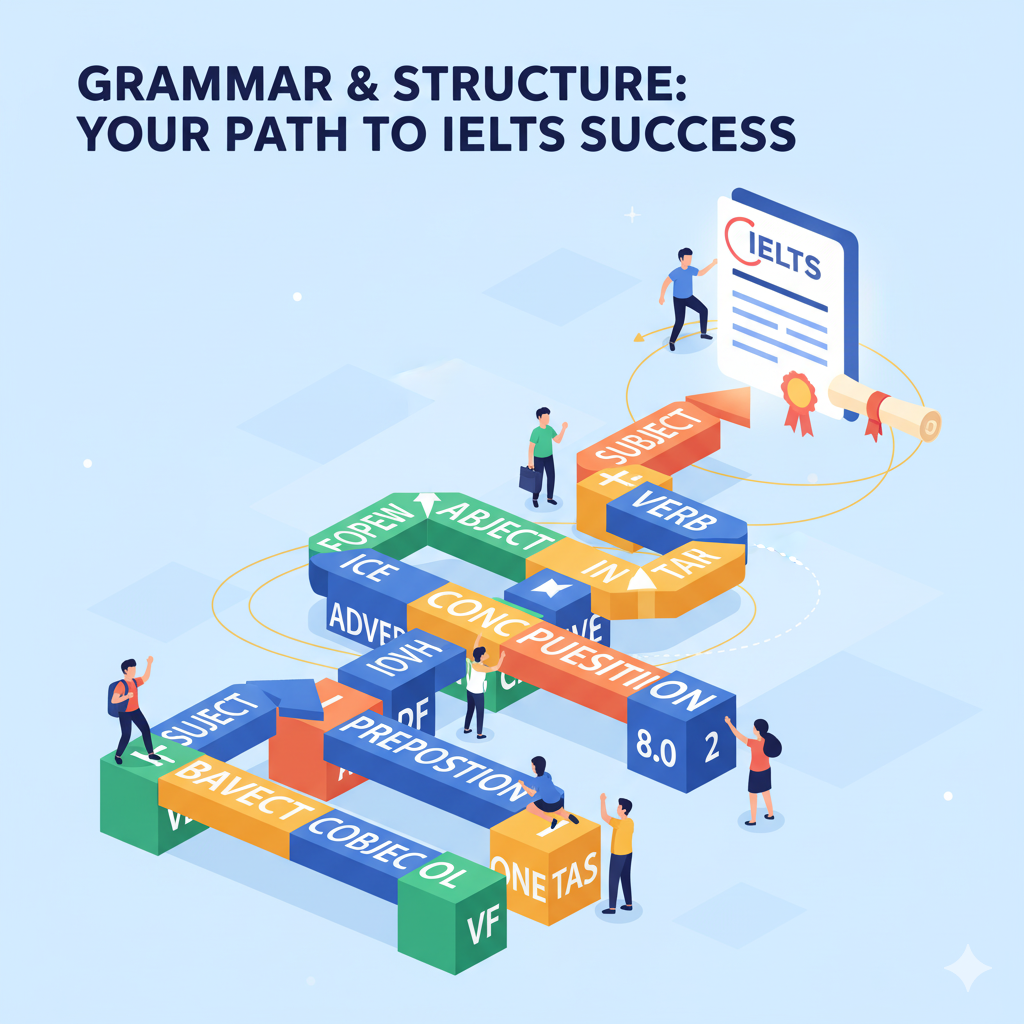
Objective:
Understand how to identify and build simple, compound, and complex sentences correctly, and use them effectively to improve coherence and grammatical range in IELTS Writing and Speaking.
🔍 Overview
🌿 What Is a Sentence?
A sentence is a group of words that expresses a complete thought. It must have a subject (who/what the sentence is about) and a predicate (what the subject does or is).
In IELTS, writing strong and varied sentences helps you communicate ideas clearly, show grammatical control, and achieve higher band scores.
🧩 Types of Sentences
English language has Four basic sentence structures which are outlined below.
1️⃣ Simple Sentences
A simple sentence has one independent clause (one complete idea).
Structure:Subject + Verb (+ Object/Complement)
Examples:
- Many students struggle with time management.
- IELTS writing requires strong grammar.
✅ IELTS use: Use simple sentences to express clear ideas and avoid grammatical mistakes in Task 1 or 2.
2️⃣ Compound Sentences
A compound sentence joins two or more independent clauses using a coordinating conjunction (FANBOYS):
For, And, Nor, But, Or, Yet, So
Structure:Clause 1 + , + Coordinating Conjunction + Clause 2
Examples:
- Some students prefer to study online, but others find classroom learning more effective.
- I practiced speaking every day, so my fluency improved significantly.
✅ IELTS use: Use compound sentences to connect ideas logically in both Task 2 essays and Speaking answers.
3️⃣ Complex Sentences
A complex sentence contains one independent clause and one or more dependent clauses (introduced by subordinating conjunctions like because, although, while, since, if, when, etc.).
Structure:Main Clause + Subordinating Conjunction + Dependent Clause
Examples:
- Although IELTS Writing is challenging, regular practice helps improve your score.
- If you use complex sentences correctly, you can reach Band 7 or higher in Grammar.
✅ IELTS use: Use complex sentences to show range and sophistication — a key criterion for Band 7+ in Writing and Speaking.
4. Compound-Complex Sentences
A compound-complex sentence combines at least two independent clauses and one or more dependent clauses.
It merges the complexity of subordination with the balance of coordination.
🔹 Structure Formula
[(IC + IC) + DC]
- IC = Independent Clause
- DC = Dependent Clause
- Coordinating Conjunctions (for ICs): and, but, or, so, yet, nor, for
- Subordinating Conjunctions (for DCs): because, although, since, when, if, unless, while, after, before
📌 Examples
- I wanted to go for a walk, but it started raining because the storm had arrived.
- She finished her novel, and she submitted it to the publisher after she revised the final chapter.
- Although he was tired, he continued working, and he managed to meet the deadline.
🧱 Sentence Components: Clauses & Connectors
✳️ Independent Clause:
A complete thought.
➡️ Example: “I enjoy reading.”
✳️ Dependent Clause:
An incomplete thought — needs an independent clause.
➡️ Example: “Because I enjoy reading.”
✳️ Common Connectors for IELTS:
| Purpose | Connectors |
|---|---|
| Cause & Effect | because, since, as, so that |
| Contrast | although, even though, while, whereas |
| Condition | if, unless, provided that |
| Time | when, after, before, while, until |
| Addition | moreover, furthermore, besides |
💬 Examples in IELTS Context
Simple:
- The graph shows a rise in online shopping.
Compound:
- The number of online buyers increased, and the demand for digital marketing grew.
Complex:
- As the population increased, the demand for housing also rose significantly.
Complound-Complext:
Although the book was lengthy, she enjoyed it , and she recommended it to her friends.
🧠 Practice Activities

💡 Tip: Use a mix of simple, compound, and complex sentences for a natural flow and higher Grammatical Range and Accuracy (GRA) score.
💎 IELTS Tip
🎯 To score Band 7+ in Grammatical Range and Accuracy, show control over different sentence structures.
Use a mix of short, clear sentences and longer, complex ones to make your essay more coherent and dynamic.
🧠 Mini Diagnostic Quiz
Choose the best sentence for IELTS Writing Task 2:
A. Many people believe technology is harmful it reduces human interaction.
B. Many people believe technology is harmful because it reduces human interaction.
C. Many people believe technology is harmful, but reduces human interaction.
✅ Answer: B — It’s a complex sentence that correctly uses the subordinating conjunction because.
🌟 Conclusion
Mastering sentence structures allows you to express ideas clearly, connect thoughts logically, and demonstrate a wide range of grammar — essential for scoring high in IELTS Writing and Speaking.
Remember:
“Grammar builds the walls of your house; sentence structure designs the rooms.”
Practice Conditional Sentences Here