
Demystifying IELTS Multiple Choice: A Strategic Guide to Precision and Accuracy
Multiple Choice (MCQ) in IELTS Reading isn’t about finding the right answer; it’s about understanding why the other three are wrong. The examiners are masters of creating “plausible distractors”—options that look correct if you’ve skimmed or misunderstood the text. This guide will train you to spot these distractors from a mile away and approach MCQs with the confidence of a seasoned editor.
Part 1: The Anatomy of an IELTS Multiple Choice Question
You will typically encounter two formats:
- Standard Multiple Choice: A question followed by four possible answers (A, B, C, D). You choose one.
- “Choose Multiple Answers” or “Select from a List”: A longer question asking you to choose, for example, two or three correct answers from a list of five or six options. The instructions are crucial here!
Part 2: The Strategy Playbook – The Art of Elimination
Your goal is not to magically pick the right answer. Your goal is to eliminate the wrong ones.
Step 1: Deconstruct the Question
Before you even look at the options, read the question stem carefully. Underline the key question words.
- What is the main reason…?
- What is the primary purpose…?
- What is the writer’s main point…?
- According to the text, what…
This tells you exactly what you are looking for.
Step 2: Predict the Answer
Based on your initial reading of the relevant text, try to formulate the correct answer in your own words before looking at the options. This prevents you from being swayed by the distractors.
Step 3: Scan for the “Target Text”
Take the keywords from the question and scan the passage to find the specific section where the answer is located.
Step 4: The Four-Way Cross-Check (The Core Strategy)
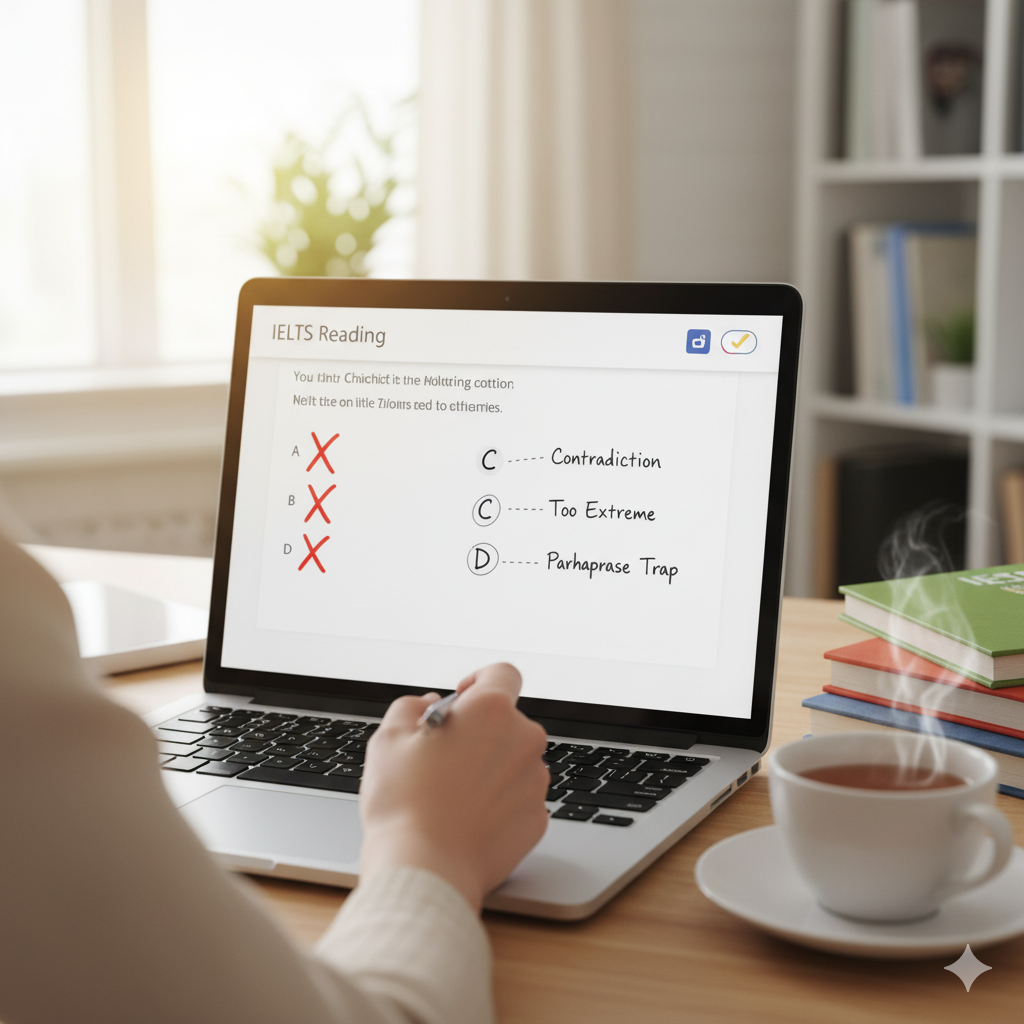
Read the target text intensively. Now, evaluate each option (A, B, C, D) one by one. Label them mentally. The incorrect options will usually fall into one of these categories:
- The Direct Contradiction: The option states the exact opposite of what the text says.
- The “Not Mentioned” or “Irrelevant Detail”: The option contains information that is not in the target text at all, or is a minor detail from another paragraph used to answer a different question.
- The “Too Extreme” or “Over-Generalization”: The option uses absolute language (
all,every,never,must) where the text uses qualified language (some,many,often,could). - The “Paraphrase Trap”: The option uses words directly from the text but in the wrong context or with a twisted meaning. This is the most common and most dangerous distractor.
Part 3: The Examiner’s Toolkit – Understanding Distractor Vocabulary
Examiners use specific words to create plausible lies. Recognizing these can instantly disqualify an option.
| “Trick” Word in Option | What it signals | What to look for in the Text |
|---|---|---|
| all, everyone, always, must | Often an Over-Generalization. | Look for qualifiers: some, a majority, often, likely. |
| never, no one, impossible | Often a Direct Contradiction. | The text will usually show that it is possible or has happened. |
| cause, lead to, result in | A claim about direct causation. | The text might only show correlation (two things happening together) or a weaker link (may contribute to). |
| the main reason, the primary purpose | A claim about primary importance. | The text might mention it as *a* reason, not the main one, or list several reasons without ranking them. |
| before, after, first, last | A claim about sequence or timing. | Check the chronology in the text carefully. |
| agree, believe, state (attributed to the wrong entity) | A misattribution of an opinion. | Check who said what. Did the author say it, or a source they are criticizing? |
Part 4: Progressive Activities & Exercises
Activity 1: Micro-Skill Builder – The Distractor Detector
- Objective: To train your brain to identify why an option is wrong, not just that it is wrong.
Instructions: Below is a sentence from a passage, followed by a question and four options. Your task is not just to find the correct answer, but to identify the type of distractor for each incorrect option.
Text Snippet: “While the invention of the printing press in the 15th century is widely credited with revolutionizing the spread of information, some historians argue that its social impact was neither immediate nor uniform across Europe.”
Question: What point do some historians make about the printing press?
Options:
A. It was invented in the 15th century.
B. Its effect on society was rapid and consistent everywhere.
C. It immediately revolutionized the spread of information.
D. Its social influence was not instant and varied by region.
Check Your Answers & Analysis (Activity 1)
Correct Answer: D. This is a perfect paraphrase of “its social impact was neither immediate nor uniform.” Distractor Analysis: A: The “Irrelevant Detail” – This is a fact stated in the text, but it is not the point that “some historians” are making. It’s a true fact used to answer the wrong question. B: The “Direct Contradiction” – The text says the impact was “neither immediate nor uniform.” This option says it was “rapid and consistent,” which is the exact opposite. C: The “Over-Generalization” / “Paraphrase Trap” – This option takes the phrase “revolutionized the spread of information” but adds the word “immediately,” which the text specifically contradicts when discussing the historians’ view.Activity 2: Unique Reading Passage & Question Set 1
The Hidden World of Plant Communication
[A] For centuries, plants were viewed as passive, silent occupants of their environment. However, pioneering research in the late 20th century began to reveal a startling reality: plants are engaged in a constant, sophisticated chatter. This communication occurs not through sound, but through volatile organic compounds (VOCs)—chemicals released into the air. When a plant is attacked by insects, it can release specific VOCs that serve as a distress signal.
[B] The function of these signals is twofold. First, they can warn neighboring plants of the impending threat. Upon detecting these VOCs, other plants may preemptively ramp up their own chemical defenses, making their leaves less palatable to the invaders. Second, the distress call can function as a metaphorical “cry for help,” attracting predatory insects that feed on the herbivores attacking the original plant. For example, a bean plant beset by mites will release a cocktail of chemicals that draws mite-eating predators to its rescue.
[C] The ecologist who first documented this phenomenon, Dr. Suzanne Simard, later discovered an even more complex network beneath the forest floor. She found that trees are interconnected by a vast, symbiotic web of fungal threads known as mycorrhizal networks. Through this “Wood Wide Web,” trees can share not just warning signals but also nutrients. A older, well-established “mother tree” can use this network to support shaded seedlings struggling to survive, effectively redistributing resources to ensure the health of the wider forest community.

Activity 3: Unique Reading Passage & Question Set 2 (Advanced)
The Paradox of Choice
[A] In the modern consumer world, we are faced with an abundance of choice unparalleled in human history. From dozens of varieties of jam to hundreds of television channels, the freedom to choose is celebrated as a cornerstone of individual autonomy and well-being. Conventional wisdom suggests that more choice should invariably lead to greater customer satisfaction and better outcomes.
[B] However, psychological research has begun to challenge this assumption, revealing a phenomenon known as the “paradox of choice.” Studies, such as one famously involving gourmet jams, demonstrated that while a large display (24 jams) attracted more initial interest, a smaller display (6 jams) resulted in significantly higher sales. The theory posits that an overabundance of options leads to cognitive overload, making the decision-making process arduous and stressful.
[C] The consequences extend beyond mere indecision. Faced with too many alternatives, individuals experience anxiety about making the “wrong” choice. Subsequently, even after a decision is made, they are less satisfied with their selection, plagued by the lingering doubt that one of the many foregone alternatives might have been superior. This post-decision regret can diminish the enjoyment of the chosen item.
[D] The author of the seminal work on this topic, Barry Schwartz, distinguishes between “maximizers” and “satisficers.” Maximizers strive to make the absolute best choice, exhaustively researching every option. Satisficers, in contrast, aim for a choice that is “good enough,” based on a few key criteria. Unsurprisingly, maximizers are more vulnerable to the paradox of choice, experiencing higher levels of stress and regret. The author’s conclusion is not that choice is bad, but that the unbridled proliferation of choice can have detrimental effects on our psychological well-being.
Part 5: Final Tips for Test Day Dominance
- Order of Attack: For MCQ questions that ask for a specific piece of information (e.g., “According to the passage, what caused X?”), tackle them as you find the relevant text. For questions about the main idea or purpose of a paragraph/passage, it’s often better to answer them last, after you have a full understanding of the text.
- Beware of “Absolute” Options: As with T/F/NG, options containing
all,every,neverare often incorrect. The correct answer is more likely to be measured and qualified. - Check the Instructions Meticulously: For “choose multiple answers” questions, double-check how many answers you need to select. Your answer will be marked wrong if you select too many or too few.
- Trust the Text, Not Your Knowledge: Your personal opinion or external knowledge is irrelevant. The answer must be 100% grounded in the passage.
By mastering the art of elimination and understanding the psychology behind the distractors, you transform the Multiple Choice section from a game of chance into a systematic process of verification. You are no longer a guesser; you are an examiner, dispassionately disqualifying incorrect options until only the truth remains.
Explore All the Reading Topics/Questions with Relevant Exercises Here