
Mastering IELTS Matching Sentence Endings: The Logic and Grammar Link
Matching Sentence Endings requires you to complete a set of sentence starters by choosing the most appropriate ending from a list. The challenge is twofold: the completed sentence must be grammatically correct and factually accurate according to the passage. This guide will provide you with a systematic method to ensure both conditions are met every time.
Part 1: The Core Challenge – Grammar and Meaning in Tandem
Many students focus only on meaning and ignore grammar, or vice-versa. Success requires both.
- Grammatical Fit: The start and end of the sentence must connect seamlessly. They must form a complete, syntactically correct sentence.
- Semantic Fit: The completed sentence must accurately reflect the information in the reading passage.
Your task is to find the ending that satisfies both conditions perfectly.
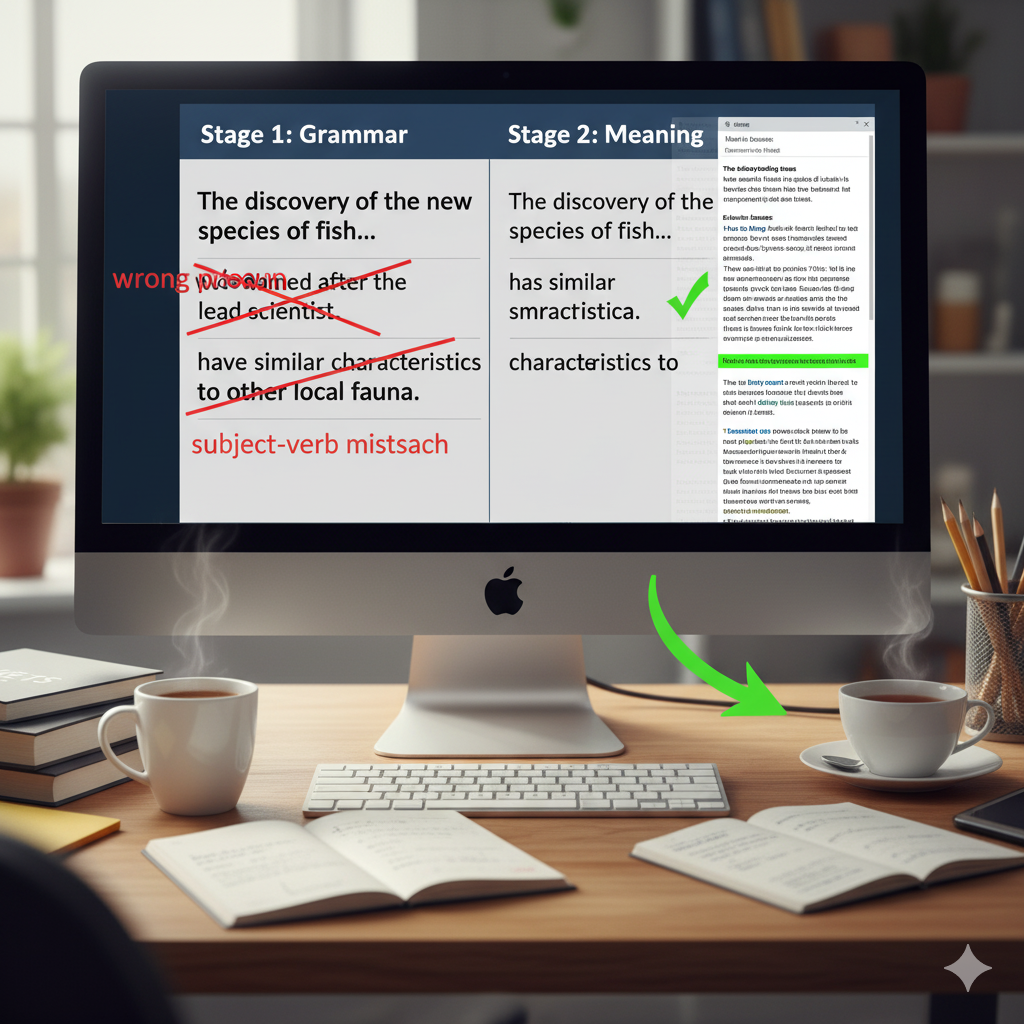
Part 2: The Strategic Blueprint – The Two-Stage Filter
This method ensures you check for both grammar and meaning systematically.
Stage 1: The Grammatical Pre-Screen (Before Reading the Text)
- Read all the sentence beginnings carefully. Underline the key idea in each one.
- Now, read all the possible endings. As you do this, quickly consider which endings could grammatically complete the beginnings. Look for:
- Pronoun Agreement: If the beginning ends with “it,” the ending must logically refer to something singular and neutral. If it ends with “they,” the ending must refer to something plural.
- Logical Connectors: If the beginning has a word like “because,” the ending must provide a reason. If it has “although,” the ending must present a contrast.
- Verb Tense and Form: The beginning might require a specific verb form in the ending (e.g., an infinitive, a gerund, a past tense).
This pre-screen allows you to eliminate obviously incorrect grammatical matches, reducing the number of options you need to check against the text.
Stage 2: The Textual Verification (Using the Passage)
- Take one sentence beginning at a time. Use the key ideas you underlined to scan the passage for the relevant information.
- Once you find the relevant section, read it intensively. Understand precisely what the text says.
- Now, look at your grammatically possible endings from Stage 1. Which one accurately completes the sentence based on the text you just read?
- Select the ending that creates a sentence that is both grammatically sound and a true reflection of the passage.
Part 3: The Examiner’s Toolkit – Logical and Grammatical Traps
Examiners create endings that are tempting for several reasons.
| The Trap | What it is | How to Avoid It |
|---|---|---|
| The “Grammatically Correct but Factually Wrong” Trap | The ending forms a perfect sentence but states something not mentioned or contradicted by the text. | Always verify with the text. Do not rely on grammar or logic alone. |
| The “Factually Plausible but Grammatically Awkward” Trap | The ending contains information from the correct part of the text but does not fit the grammatical structure of the beginning (e.g., wrong pronoun, wrong verb form). | Trust your Stage 1 Grammatical Pre-Screen. If it doesn’t sound right as a sentence, it’s probably wrong. |
| The “Keyword Distractor” Trap | An ending uses a word that appears prominently in the same paragraph as the answer, but the overall meaning is incorrect. | Focus on the full meaning of both the beginning and the ending, not just isolated vocabulary. |
| The “Opposite Meaning” Trap | The ending is grammatically perfect but states the opposite of what the text says. | Read the target text carefully. Pay attention to negative prefixes (un-, in-, dis-) and words of negation (few, rarely, instead of). |
Part 4: Progressive Activities & Exercises
Activity 1: Micro-Skill Builder – The Grammar and Logic Filter
- Objective: To practice the crucial first stage of eliminating endings based solely on grammar and logic, before even seeing the text.
Instructions: For each sentence beginning (1-3), choose the most logical and grammatically sound ending from the list (A-E). There are more endings than beginnings, so you will not use them all.

Activity 2: Unique Reading Passage & Question Set 1
The Science of Memory Consolidation
[A] Memory is not a perfect recording but a dynamic process. When we first learn something, it is stored as a fragile, short-term memory in a part of the brain called the hippocampus. For this memory to become permanent, it must be transferred to the cortex in a process known as consolidation. This process is not instantaneous; it can take hours, or even days, to complete.
[B] Sleep plays a surprisingly active role in this consolidation process. During deep sleep and the rapid eye movement (REM) stage, the brain rehearses and strengthens the neural pathways formed during the day. Studies have shown that people who sleep after learning a new task perform significantly better on subsequent tests than those who stay awake. It is as though the brain uses this downtime to file away important information, discarding irrelevant details in the process.
[C] This understanding has practical implications. It suggests that “cramming” for an exam all night is counterproductive. While it might get information into your short-term memory, the lack of sleep prevents proper consolidation, meaning you are likely to forget it quickly. A more effective strategy involves repeated review over several days, allowing sleep to cement the learning after each session. Furthermore, studies indicate that even short naps can enhance memory consolidation for recently learned material.
Questions 1-4
Complete each sentence with the correct ending, A-G, below.
Write the correct letter, A-G.
Activity 3: Unique Reading Passage & Question Set 2 (Advanced)
The Economics of Attention
[A] In the digital age, a new economic paradigm is emerging where the primary scarce resource is no longer information, but human attention. With an endless supply of content vying for a finite amount of conscious time, attention has become a valuable commodity. This “attention economy” is the bedrock upon which modern tech giants like Google and Meta have built their fortunes. Their business models rely on capturing user attention and selling it to advertisers.
[B] This relentless competition for focus has significant cognitive consequences. Constant notifications and the allure of infinite scrolling train our brains for distraction, making sustained, deep focus increasingly difficult. This state of perpetual partial attention can lead to reduced productivity and increased stress. Moreover, content creators are incentivized to produce material that is immediately engaging—often through outrage or sensationalism—rather than intellectually nourishing, leading to a shallower public discourse.
[C] Some designers and ethicists are now calling for a shift in how technology is built. They advocate for “humane design” principles that prioritize user well-being over engagement metrics. This could include features that discourage endless use, such as grayscale mode to make screens less visually appealing, or prominent reminders of time spent on an app. The goal is to create tools that serve human intentions, rather than hijacking our psychological vulnerabilities for profit.
[D] Ultimately, managing one’s attention in this environment is becoming a crucial life skill. It requires conscious effort and the implementation of personal strategies, such as designated “focus hours” with notifications turned off, or the use of website blockers. The individuals and societies that learn to protect their collective attention will be better equipped to solve complex problems, foster creativity, and maintain mental well-being in the 21st century.
Questions 1-5
Complete each sentence with the correct ending, A-H, below.
Write the correct letter, A-H.
Part 5: Final Tips for Test Day Success
- Use the Two-Stage Filter Religiously: The Grammatical Pre-Screen will save you a tremendous amount of time by eliminating impossible matches before you even look at the text.
- Pay Attention to “Little Words”: Pronouns (it, they, this), articles (a, an, the), and connectors (because, although, and) are your best friends for narrowing down options.
- Verify the Complete Sentence: Once you have a match, read the entire completed sentence from start to finish. Does it sound right? Does it mean what the passage says?
- Look for Synonyms, Not Just Keywords: The correct ending will paraphrase the text, not copy it directly.
By mastering this two-stage process, you approach Matching Sentence Endings not as a guessing game, but as a logical, step-by-step verification process. You will confidently create sentences that are structurally sound and factually impeccable.
Explore All Reading Topics/Questions with their particular strategies and exercises Here