
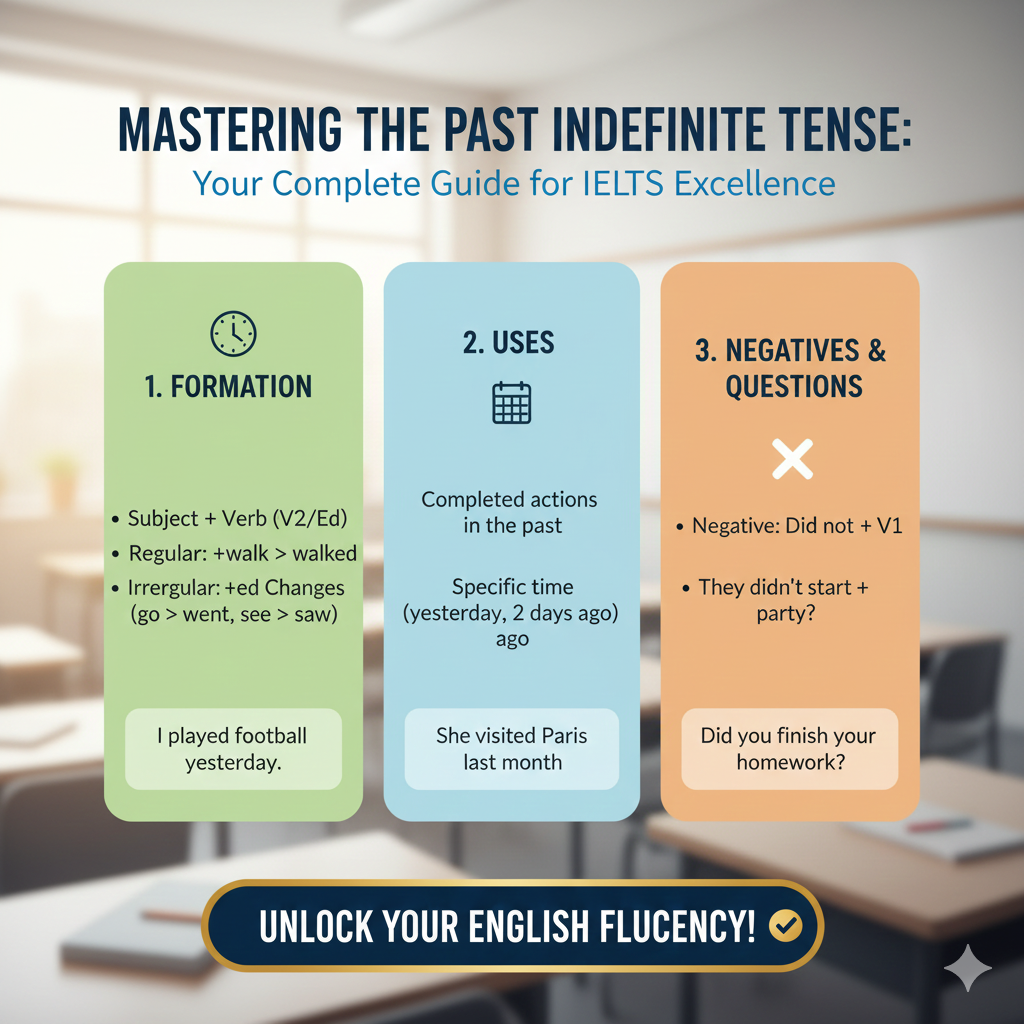
Why the Past Indefinite Tense is Crucial for IELTS
The Past Indefinite Tense (also known as the Simple Past) is the cornerstone of describing completed actions in the past. For IELTS, particularly in Task 1 Academic Writing where you describe trends, processes in the past, or past data, mastery of this tense is non-negotiable. It also dominates Speaking Part 2 (cue cards) and appears frequently in all other sections. This comprehensive guide will take you from understanding the basics to advanced application, ensuring you use this tense with precision and confidence.
Section 1: Foundation – Understanding Past Indefinite Tense
What is Past Indefinite Tense?
It is used for:
- Actions completed at a specific time in the past.
- Past habits or states.
- Sequences of past actions in storytelling.
Structure: Subject + V2 (Second Form of Verb) + Object
Example: The unemployment rate fell significantly in 2010.
Negative: Subject + did not + V1 (Base Form)
Example: The figures did not improve in the subsequent quarter.
Question: Did + Subject + V1?
Example: Did the consumption increase in 2015?
Section 2: Comprehensive Verb Tables
Table 1: 100 Most Common Verbs (Regular & Irregular) for Overall IELTS
| Base Form (V1) | Past Simple (V2) | Past Participle (V3) | Type |
|---|---|---|---|
| be | was/were | been | Irregular |
| have | had | had | Irregular |
| do | did | done | Irregular |
| say | said | said | Irregular |
| go | went | gone | Irregular |
| get | got | got/gotten | Irregular |
| make | made | made | Irregular |
| know | knew | known | Irregular |
| think | thought | thought | Irregular |
| take | took | taken | Irregular |
| see | saw | seen | Irregular |
| come | came | come | Irregular |
| want | wanted | wanted | Regular |
| look | looked | looked | Regular |
| use | used | used | Regular |
| find | found | found | Irregular |
| give | gave | given | Irregular |
| tell | told | told | Irregular |
| work | worked | worked | Regular |
| call | called | called | Regular |
| try | tried | tried | Regular |
| ask | asked | asked | Regular |
| need | needed | needed | Regular |
| feel | felt | felt | Irregular |
| become | became | become | Irregular |
| leave | left | left | Irregular |
| put | put | put | Irregular |
| mean | meant | meant | Irregular |
| keep | kept | kept | Irregular |
| let | let | let | Irregular |
| begin | began | begun | Irregular |
| seem | seemed | seemed | Regular |
| help | helped | helped | Regular |
| talk | talked | talked | Regular |
| turn | turned | turned | Regular |
| start | started | started | Regular |
| show | showed | shown | Irregular |
| hear | heard | heard | Irregular |
| play | played | played | Regular |
| run | ran | run | Irregular |
| move | moved | moved | Regular |
| like | liked | liked | Regular |
| live | lived | lived | Regular |
| believe | believed | believed | Regular |
| hold | held | held | Irregular |
| bring | brought | brought | Irregular |
| happen | happened | happened | Regular |
| write | wrote | written | Irregular |
| provide | provided | provided | Regular |
| sit | sat | sat | Irregular |
| stand | stood | stood | Irregular |
| lose | lost | lost | Irregular |
| pay | paid | paid | Irregular |
| meet | met | met | Irregular |
| include | included | included | Regular |
| continue | continued | continued | Regular |
| set | set | set | Irregular |
| learn | learned/learnt | learned/learnt | Both |
| change | changed | changed | Regular |
| lead | led | led | Irregular |
| understand | understood | understood | Irregular |
| watch | watched | watched | Regular |
| follow | followed | followed | Regular |
| stop | stopped | stopped | Regular |
| create | created | created | Regular |
| speak | spoke | spoken | Irregular |
| read | read | read | Irregular |
| spend | spent | spent | Irregular |
| grow | grew | grown | Irregular |
| open | opened | opened | Regular |
| win | won | won | Irregular |
| offer | offered | offered | Regular |
| remember | remembered | remembered | Regular |
| love | loved | loved | Regular |
| consider | considered | considered | Regular |
| appear | appeared | appeared | Regular |
| buy | bought | bought | Irregular |
| wait | waited | waited | Regular |
| serve | served | served | Regular |
| die | died | died | Regular |
| send | sent | sent | Irregular |
| build | built | built | Irregular |
| stay | stayed | stayed | Regular |
| fall | fell | fallen | Irregular |
| cut | cut | cut | Irregular |
| reach | reached | reached | Regular |
| kill | killed | killed | Regular |
| remain | remained | remained | Regular |
| suggest | suggested | suggested | Regular |
| raise | raised | raised | Regular |
| pass | passed | passed | Regular |
| sell | sold | sold | Irregular |
Table 2: Essential Verbs for IELTS Writing Task 1 (Describing Trends, Data, Processes)
| Base Form (V1) | Past Simple (V2) | Past Participle (V3) | Usage Context |
|---|---|---|---|
| increase | increased | increased | Increasing trends |
| decrease | decreased | decreased | Falling trends |
| rise | rose | risen | Sharp rise |
| fall | fell | fallen | Sharp decreases |
| grow | grew | grown | Gradual increase |
| decline | declined | declined | Gradual decrease |
| peak | peaked | peaked | Highest point |
| drop | dropped | dropped | Sudden fall |
| climb | climbed | climbed | Steady increase |
| plummet | plummeted | plummeted | Dramatic fall |
| double | doubled | doubled | Increased twofold |
| triple | tripled | tripled | Increased threefold |
| halve | halved | halved | Reduced by 50% |
| fluctuate | fluctuated | fluctuated | Varied irregularly |
| stabilize | stabilized | stabilized | Became steady |
| plateau | plateaued | plateaued | Remained stable |
| overtake | overtook | overtaken | Exceeded |
| surpass | surpassed | surpassed | Went beyond |
| constitute | constituted | constituted | Made up |
| account for | accounted for | accounted for | Represented |
| illustrate | illustrated | illustrated | Showed |
| demonstrate | demonstrated | demonstrated | Showed clearly |
| reveal | revealed | revealed | Showed |
| dip | dipped | dipped | Small temporary drop |
| soar | soared | soared | Rapid increase |
| plunge | plunged | plunged | Rapid decrease |
| oscillate | oscillated | oscillated | Moved back and forth |
| level off | leveled off | leveled off | Stopped rising/falling |
| witness | witnessed | witnessed | Experienced (period witnessed growth) |
Section 3: Activity Set – From Beginner to Advanced

Section 4: Strategic Application Across IELTS Modules
Writing Task 1 (Academic):
- Line/Bar Charts: Use for describing past trends. “Expenditure on healthcare rose from 10% to 15% over the decade.”
- Process Diagrams: Use passive past for historical/manufacturing processes. “The raw materials were transported to the factory.”
- Maps: Use for describing past layouts. “In 1960, the town had only one school located to the north.”
Pro Tip: Group data by trend, not by year. Use “From 1990 to 2000,” then list all changes in that period using Past Indefinite.
Speaking:
- Part 1 (Past Habits): “I used to play football when I was younger.”
- Part 2 (Cue Cards): Structure your story chronologically with Past Indefinite for main actions.
- Part 3 (Abstract Discussion): “How did transportation change in the past century?”
Writing Task 2:
Use Past Indefinite for historical examples supporting your arguments.
“For example, the invention of the internet revolutionized communication.”
Listening & Reading:
Train yourself to identify time markers that signal Past Indefinite: Yesterday, Last…, In 1990, During the 20th century, Initially, Originally, Previously.
Section 5: Common Pitfalls and How to Avoid Them
- Mixing present and past when describing past data:
Incorrect: The chart shows that in 2005, the figure increases.
Correct: The chart shows that in 2005, the figure increased. - Using Past Indefinite for unfinished past time:
Incorrect: I lived in London for 5 years. (If you still live there)
Correct: I have lived in London for 5 years. - Forgetting to change the verb in questions/negatives:
Incorrect: Did the rate increased? / It did not increased.
Correct: Did the rate increase? / It did not increase. - Overusing “was” + V-ing: Reserve Past Continuous for interrupted actions or specific ongoing past background.
Final Mastery Checklist
Before you finish, ensure you can:
- Form correct positive, negative, and interrogative sentences in Past Indefinite.
- Recite the V2/V3 forms of the 50 most common irregular verbs without hesitation.
- Describe a line graph from 20 years ago using only appropriate past tense verbs.
- Tell a 2-minute personal story using Past Indefinite as the primary tense.
- Identify and correct common past tense errors in sample Task 1 answers.
- Use at least 10 different “trend verbs” from Table 2 accurately in sentences.
Conclusion: From Learning to Application
Mastering the Past Indefinite Tense is not just about memorizing verb forms; it’s about developing the instinct to accurately frame the past. For IELTS, this precision directly impacts your Task Achievement and Grammatical Range scores. Practice the activities sequentially, internalize the verb lists, and consciously apply this tense in your daily English practice. When you can describe the past with clarity, variety, and accuracy, you have unlocked a fundamental component of IELTS success.
Remember: Language learning is a journey. Bookmark this page, return to the activities regularly, and use the verb tables as a quick reference until the past forms become second nature. Your path to IELTS Band 7+ starts with mastering these fundamental building blocks.
Good luck with your preparation!