
Read the extracts from two separate paragraphs of a Rading passage. What type of information has been underlined?
A a description of an animal’s habitat
B the issues that can cause something to happen
C an argument for a type of action
A
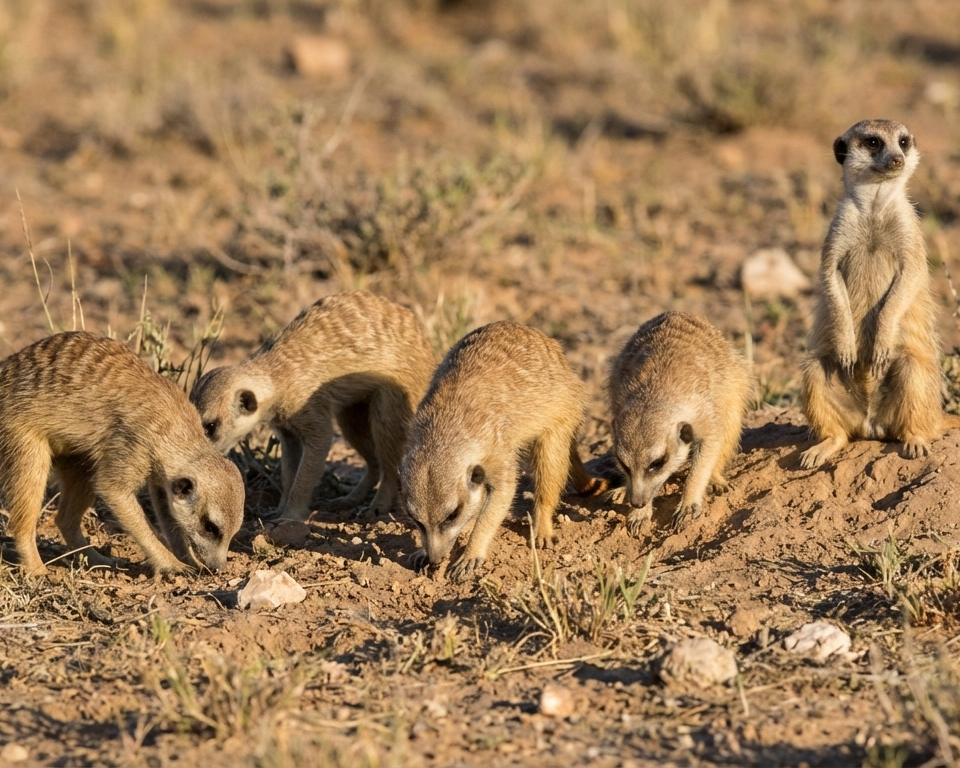
Meerkats devote a significant part of their day to foraging for food with their sensitive noses. When they find it, they eat on the spot. Primarily, meerkats are insectivores, which means their diet is mainly made up of insects.
B
These animals are transient by nature and move if their food is in short supply of if they are forced out by a stronger gang. The group’s dominant male, the alpha male, marks the group’s territory to protect the boundary from rivals and predators.
Look at this matching information task based on the extracts above.
| Which paragrah contains the following information? 1 two situations that force meerkats to change where they live 2 how meerkats generally spend their time |
For this type of question, do you need to look for individual words or a whole idea?
These questions describe the information you need to find.
1.1 Look at the type of information, A-H taken from other Reading Texts. Identify them and match to the type of information given below.
Types of information
1 the findings of a study
2 the method used in a research study
3 the reaction to something
4 a description of a habitat
5 the difference between current and past studies
6 a description of how something works
7 the cuase of something
8 the amount of time needed for something

2 Locating and matching information
NB Just like matching headings, matching information questions are not in the same order as the passage
| Study Tip Some examples of the type of information you may be asked to find are: a number, a cuase, a finding, a date, an effect, an account, a measurement, a conclusion, a reaction, a reason, the prblems, a desctiption |
2.1 Spend two minutes skim reading the article below, to get familiar with the type of information it has.
What is the overall motive of the article?
A to illustrate the living and eating routine of one particular animal
B to explain the background to a proposed study into tropical animals
C to argue that scientists can learn a great deal from studying nature
D to give the findings of new research into an animal’s behaviour.
How geckos cope with wet feet
A
Geckos are remarkable little lizards, clinging to almost any dry surface, and Alyssa Stark, from the University of Akron, US, explains that they appear to be equally happy scampering through tropical rainforest canopies as they are in urban settings. ‘A lot of gecko studies look at the very small adhesive structures on their toes to understand how the system works at the most basic level,’ says Stark. She adds that the animals grip surfaces with microscopic hairs on the soles of their feed, which make close enough contact to be attracted to the surface by the minute forces between atoms.
B
However, she and her colleagues Timothy Sullivan and Peter Niewiarowski were curious about how the lizards cope on surfaces in their natural habitat. Explaining that previous studies had focused on the reptiles clinging to artificial dry surfaces, Stark says ‘We know they are in tropical environments that probably have a lot of rain and geckos don’t suddently fall out of the trees when it’s wet’. Yet, the animals do seem to have trouble getting a grip on smooth, wet, articial surfaces, sliding down wet vertical glass after several steps. The team decided to find out how geckos with wet feet cope on both wet and dry surfaces.
C
First, they had to find out how well their geckos clung onto glass with dry feet. Fitting a tiny harness around the lizard’s pelvis and gently lowering the animal onto a plate of smooth glass, Stark and Sullivan allowed the animal to become well attached before connecting the harness to a tiny motor and gently pulling the lizard until it came unstuck. The geckos hung on tenaciously, and only came unstuck at forces of around 20N – about 20 times their own body weight. ‘In my view, the gecko attachment system is over-designed,’ says Stark.
D
Next, the trio sprayed the glass plate with a mist of water and re-tested the lizards, but this time the animals had problems holding tight. The droplets were interfering with the lizards’ attachment mechanism, but it wasn’t clear how. and when the team immersed the geckos in a bath of room-temperature water with a smooth glass bottom, the animals were completely unable to anchor themselves to the smooth surface. ‘The toes are super-hydrophobic,’ (i.e. water repellent) explains Stark, who could see a silvery bubble of air around their toes. But, they were unable to displace the water around their feed to make the tight contact that usually keeps the geckos in place.
E
Then the team tested the lizard’s adhesive forces on the dry surface when their feet had been soaking for 90 minutes, and found that the lizards could barely hold on, detaching when they were pulled with a force roughly equalling their own weight. ‘That might be the sliding behavious that we see when the geckos climb vertically up misted glass’, says Stark. So, geckos climbing on wet surfaces with dampt feet are constantly on the verge of slipping and Stark adds that when the soggy lizards were faced with the misted and immersed horizontal surfaces, they slipped as soon as the rig started pulling. Therefore geckos can walk on wet surfaces, as long as their feet are reasonablly dry. However, as soon as their feet get wet, they are barely able to hang on, and the team is keen to understand how long it takes geckos to recover from a drenching.