
- Look quickly at the block of text. Find the words Sahel and desertification and highlight them. Then answer the questions below.
| dkdnnvtruenncmcompletinomnSahelvocmdessertnfindfksssjoodesertificationdeesosjdvfnvffkmvmdmvfalsekdwrfvdcnvtextadnvmlffl |
a. Why can you see the Word Sahel easily? Choose a reason.
- because it is a large word
- because it is in the middle of the text
- because it has a capital letter
- because you don’t have to look for the meaning.
b. Can you see the word desertification as easily? Why/Why not?
2. When you scan a piece of text, you look over it to find one word or phrase, not to understand the whole text. Which of the suggestions a-g do you think are most helpful for scanning?
a. Look only for specific words or phraes.
b. Look for each word or phrase in turn.
c. Look at every word in the text.
d. Try not to think of the meaning as you scan.
e. Use a pencil to guide you.
f. Underline the word when you find it.
g. Think of the meaning of the word you are looking for.
3. The box below contains words and phrases from the text ‘Deforestation and desertification’. Scan the text to find the words, then highlight them. The first word has been underlined for you.
| zone marginal steadily crept Botswana increasing population overcultivation plant species management |
Deforestation and Desertification
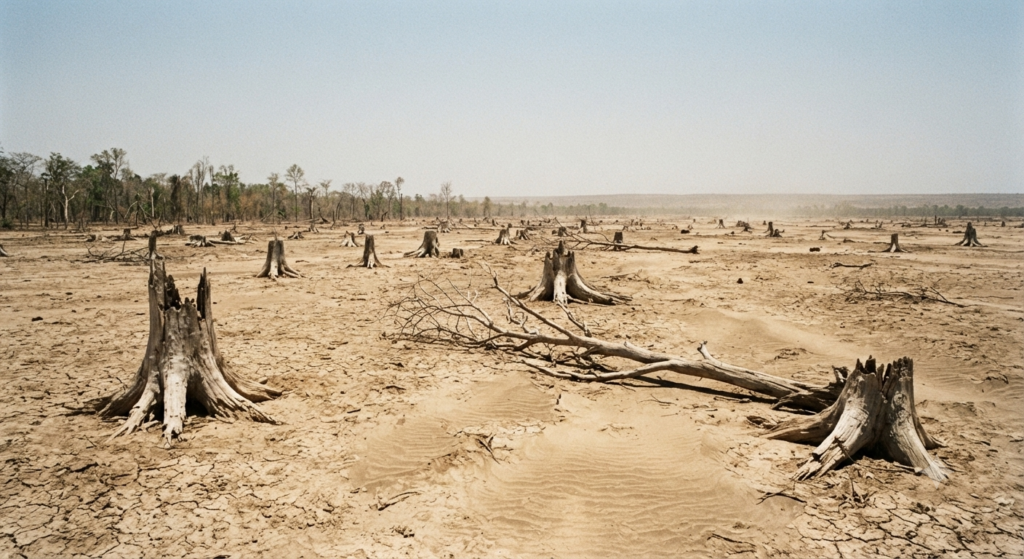
A The Sahel zone lies between the Sahara desert and the fertile savannahs of northern Nigeria and southern Sudan. The word sahel comes from Arabic and means marginal or transitional, and this is a good description of these semi-arid lands, which occupy much of the West African countries of Mali, Mauritania, Niger and Chad.
B Unfortunately, over the last century the Sahara desert has steadily crept southwards, eating into once productive Sahel lands. United Nations surveys show that over 70 per cent of the dry land in agricultural use in Africa has deteriorated over the last 30 years. Droughts have become more prolonged and more severe, the most recent lasting over 20 years in parts of the Sahel region. The same process of desertification is taking place across southern Africa as the Kalahari desert advances into Botswana and parts of South Africa.
C One of the major causes of this desert advance is poor agricultural land use, driven by the pressures of increasing population. Overgrazing – keeping too many farm animals on the land – means that grasses and other plants cannot recover, and scarce water supplies are exhausted. Overcultivation – trying to grow too many crops on poor land – results in the soil becoming even less fertile and drier, and beginning to break up. Soil erosion follows, and the land turns into desert.
D Another cause of desertification is loss of tree cover. Trees are cut down for use as fuel and to clear land for agricultural use. Tree roots help to bind the soil together, to conserve moisture and to provide a habitat for other plants and animals. When trees are cut down, the soil begins to dry and loosen, wind and rain erosion increase, other plant species die and eventually the fertile topsoil may be almost entirely lost, leaving only bare rock and dust .
E The effects of loss of topsoil and increased drought are irreversible. They are, however, preventable. Careful conservation of tree cover and sustainable agricultural land use have been shown to halt deterioration of soils and lessen the effects of shortage of rainfall. One project in Kita in south-west Mali funded by the UNDP has involved local communities in sustainable management of forest, while at the same time providing a viable agricultural economy based on the production of soaps, beekeeping and marketing shea nuts. This may be a model for similar projects in other West African countries .
Activity 1
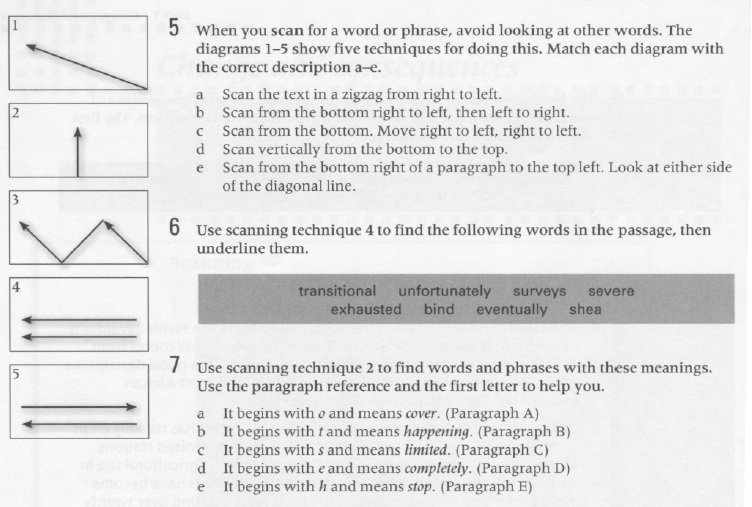
8. Choose a scanning technique from above. Scan the whole text for words or phrases with these meanings.
a. It begins with p and means long.
b. It begins with p and means fertile.
c. It begins with e and means wearing away.
9. Sentence Completion
Read the sentences below and figure out whether the missing words are adjectives or nouns.
And then complete these sentences using NO MORE THAN TWO WORDS from the passage.

Activity 2: True / False / Not Given
Statements 1-7 are taken from a True/False/Not Given task. Underline words which could be used to scan the passage. Explain your choices.
Example
The semi-arid land of the Sahel is found only in Mali.
Scan for Mali because it is easy to see (capital letter) and cannot be expressed in another way.
Decide if the following statements agree with the information given in the passage.
12. Look again at the statements above. Highlight words that qualify or limit each statement, especially adverbs and adjectives.
Example
The semi-arid land of the Sahel is found only in Mali.
13. Decide whether the statements above are True, False or Not Given according to the passage.
14. Explain why each statement 1-4 below is Not Given in the text. Use the example to help you.
Example
The Sahel covers more of the land in Mali than it does in Chad.
Not Given because there is no comparison in the text. We know that it covers much of Mali and Chad, but we do not know which country has more.
- Agricultural land in Africa could deteriorate further in the coming years.
- There could be another severe drought in the Sahel over the next three decades.
- In some areas, the UNDP may provide financial support for forestry management to local communities in the future.
- A second project has been planned in Mali to develop sustainable forestry management.
Reading Passage 1
You should spend 20 minutes on questions 1-14 which are based on Reading Passage1
Swallows in Migration
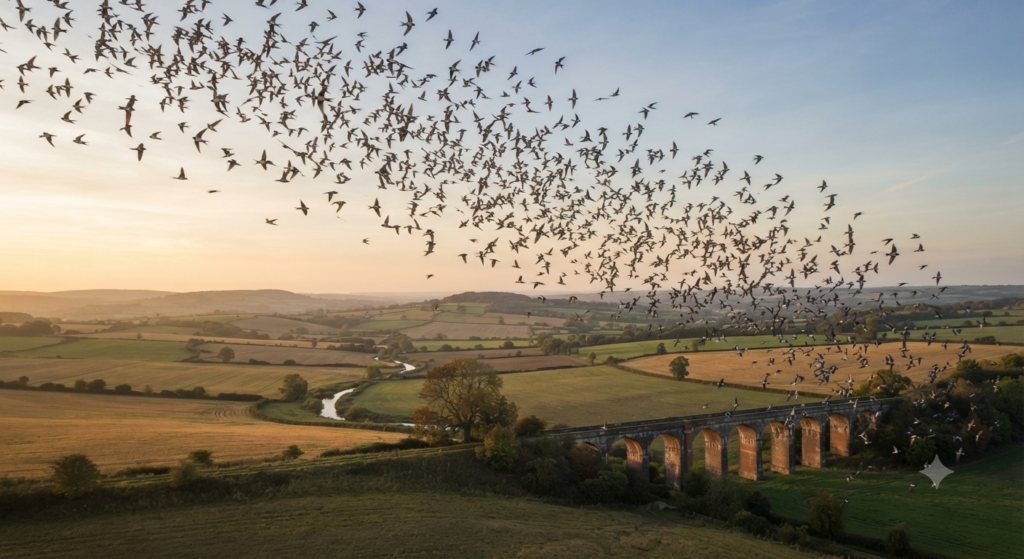
Every April, along with many other species of birds, the swallow arrives to spend the summer months in northern Europe, in Russia, Iran and parts of Siberia. Here it will breed and raise its young.
The swallow is well known for several reasons. Firstly, it is very distinctive, with its forked tail and characteristic acrobatic swooping flight. Secondly, it is very common, and, like its near relative the house martin, lives in close proximity to human habitation, at least in rural areas. It is, however, rarely to be encountered in towns or cities.
For centuries, people have observed swallows, noted their arrival and their patterns of feeding. In several countries, these observations have passed into the language as proverbs or sayings. In England, people comment on unpredictable late spring weather by saying, ‘one swallow does not a summer make’. Similarly, ‘the swallows are flying low’ was held to predict rainy, even stormy weather. There may be some truth in this observation, though it is the insects the swallows feed on that seem to be more susceptible to the fall in barometric pressure that heralds a storm. Insects keep low in these conditions, and so do the swallows that hunt them. At the end of the summer season, when the swallows are about to leave, they frequently flock together in large numbers on convenient high open perches, like roof ridges and telegraph wires. When people remark that ‘the swallows are gathering’, they mean that autumn has arrived.
At some point in mid-September the swallows leave together, usually all on the same day. One day there are thousands, the next there are none, and none will be seen again until the following spring. For centuries, this was a complete mystery to people. The Hampshire naturalist Gilbert White, writing in the late eighteenth century, believed that the swallows dived into ponds and rivers in autumn and remained in the bottom mud the whole winter, re-emerging the following spring. This idea seems extraordinary to us, but White was not a stupid man: many of his other observations of natural life were informed and accurate. In this case, however, he simply had no means of determining the truth and was forced to make a random guess. The idea that swallows migrate to central or southern Africa would have seemed as fanciful to him as his theory seems to us.
Although we now know that swallows migrate, there are still unanswered questions. Why do they go so far? Why not stay on the shores of the Mediterranean? The majority continue to equatorial Africa, and some even further south. Also it appears that populations of swallows that have bred in different countries also spend the winter in different areas. Those from France, Germany and much of western Europe have mostly been traced to East Africa, Kenya or Tanzania for example. Above all, how does a bird weighing approximately twenty grams find its way across mountain ranges, ocean and desert to winter in the south, and then return the following year to the very location it was born, in some cases to the very same nest?
Birds can navigate by the Sun, and are also able to detect the magnetic field of the Earth. Species that migrate at night are also able to navigate by the stars. By these means, they travel long distances. The close navigation that brings them back to the same field or nest appears to be related to memory of local landmarks imprinted on the minds of young birds as they crisscross the area in the weeks before departure.
Nevertheless, the journey is very dangerous. Long sea crossings, where there is little available food or water, are generally avoided. In western Europe, most swallows cross to Africa via the Straits of Gibraltar, or fly the length of Italy before tackling the relatively short crossing to Tunisia in North Africa. However, in storms they may be blown hundreds of kilometres off course. Exhausted swallows sometimes come to rest on ships way out in the Atlantic Ocean. They have to cross mountain ranges too, where again the weather may be unpredictable and food scarce. Along the coast of North Africa, many young swallows become the prey of Eleonora’s falcons, which time their breeding to coincide with the migration of young birds southwards. But the most dangerous part of the journey is the crossing of the Sahara desert. Here, there is little food or water, sandstorms may delay and exhaust the already weakened birds, and many die. It is estimated that around 50 per cent of adult birds die, and up to 80 per cent of young birds, but enough survive to ensure the continuation of the species.
Questions 1-6 (True / False / Not Given)
Do the following statements agree with the information given in the passage?
Choose
TRUE if the statement agrees with the information
FALSE if the statement contradicts the information
NOT GIVEN if there is no information on this
Questions 7-12 (Sentence Completion)
Complete the sentences. Choose NO MORE THAN TWO WORDS from the passage for each answer.
Improve your IELTS word skill
1: Complete the sentences with a word from the box.
| 1. consequence 2. factor 3. change 4. result 5. impact 6. effect 7. cause 8. role |
a. Technology has had a huge………………….on our lives.
b. The area has undergone many ……………. in recent years.
c. Planting trees can have a knock-on ………….on the economy of arid areas.
d. Deforestation can have unforeseen …………for the ecology of a region.
e. It is sometimes difficult to discover the exact ………… of a problem.
f. To achieve the best………, it is important to imitiate change at a local level.
g. The main………….contributing to success in any organization is a happy workforce.
h. The climate has played a major…………….in this region’s economic history.
2. Complete the sentences with a phrase from the box.
| 1. gradual development 2. limited impact 3. far-reaching consequences 4.dramatic changes 5. favourable outcome 6. underlying cause 7. profound effect |
a. Government intervention has had……….for regional growth.
b. Shock tactics can bring about ………in peoples behaviour.
c. …………………….is much more acceptable than rapid change.
d. The introduction of new farming practices has had a …………….on people’s lives.
e. To achieve the most ………….., the countries involved need to negotiate.
f. The ………………in this particular case is not easy to find.
g. The huge sums invested had only a ………….on the neighborhood.
3. Decide whether the words in brackets have the same or opposite meaning to the words in italic.
Example
Tourists have changed the coastline dramatically. (slightly) Opposite meaning
a. The wasteland was completely transformed. (totally)
b. The government fully accept the consequences of their actions. (partially)
c. The marine life in the coral reef is highly sensitive to temperature fluctuations. (exceedingly)
d. Alternative sources of energy like solar power can vastly improve life in remote communities. (marginally)
e. The rising sea level will greatly affect the livelihoods of people on some Pacific islands. (considerably)