

Rank these factors from 1 to 10 in terms of importance for your health (1 = most
important).
- not smoking
- not drinking alcohol
- getting enough sleep
- avoiding stress
- eating healthy food
- keeping in touch with friends and family
- taking regular exercise
- avoiding exposure to the sun
- avoiding polluted areas
- getting immunised against preventable diseases
Discuss these questions.
1 Why do some people find it difficult to do the right thing for their health and
well-being?
2 Do you think enough is done to promote campaigns for/against any of the factors in
Exercise 2?
3 Which of these things should be controlled by the government, and which should be
left to the individual?
Health and happiness collocations
Make as many collocations connected with health and happiness as you can by combining words and phrases from box A with those from box B.
| A chill cut down on feel-good fit as a on cloud out of over the · sedentary splitting stop be in high watch | B your weight spirits smoking out condition factor fiddle headache lifestyle modified starch moon nine |

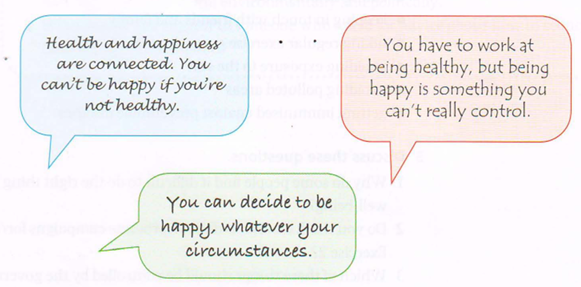
Discuss to what extent you agree with these comments, and explain why.
Skimming and scanning
While you can go into the IEL TS test with a lot of confidence and even enthusiasm, one thing you don’t have a lot of in the exam is time. Your ability to read quickly and to process the information effectively is of paramount importance. Each text that you have to read will be up to 900 words long, so you need to develop the ability to read quickly. Two key techniques that can help you do this are skimming and scanning.
Skimming strategies
Skimming involves running your eyes quickly over the text to find out the main ideas contained within it.
I t is useful to:
- read the questions first to know what you are looking for
- read the title of the text and any subheadings
- read the first paragraph to see where the article is heading
- read the first line of each subsequent paragraph
- read the last paragraph, which may include a summary and/ or conclusion
- see how any diagrams or pictures could relate to the article.
While skimming, you should: - try to read three or four times faster than normal
- get a good idea of what the article is about without checking new words in the dictionary
- underline key words, e.g. dates, places, figures
- focus on key words like nouns, verbs, adjectives.
Scanning strategies
When you look for someone’s name in a telephone directory or look a word up in a dictionary, you don’t read every line. You can scan through the text to find the
information that you are looking for. For this to be successful, you need to know what you are looking for. That means you should read the question first and identify key words in it to guide you.
It is useful to: - read the questions so you know what you are looking for
- find the relevant part of the text as quickly as possible
- avoid reading the text line by line
- avoid mouthing the words as you read
- be aware of key words in the distractors that may also occur in the text. They may wrongly make you think you have the right part of the text.
While scanning, you should: - look for key words in the text – nouns that reflect the questions, and words like problem, solution, idea, goal, improvement, danger
- look for key words that help you interpret the text and the writer’s opinion – verbs like must, can, help, ensure, increase, offer, measure, change, and adjectives and adverbials like probably, without doubt, definitely, possible, much worse, small, large, regularly, often, rarely, always, all, few, some and so on.
- think of paraphrases for key words from the question and look for them in the text.
The two strategies – skimming and scanning – work together. If you have skimmed the text effectively, then you will have a better idea of where to find the information you are looking for. You may have underlined an important fact, date, figure or key word. - While scanning, you may notice other key words which you can underline.
Five ways to practise skimming and scanning
1 Get into the habit of reading longer texts and articles in English regularly.
2 Pay particular attention to the first and last paragraphs of an article.
3 To get the key ideas of a text, before you read, ask yourself: who, where, what, why, when and how, how many, how much? Try to find the answers to those questions as you read through an article.
4 Don’t focus on new vocabulary, and don’t use a dictionary on your first reading of a text.
5 Don’t try to vocalize the text as you read – use your eyes, not your voice.
1 Practise your skimming and scanning with the article below about happiness. Read it quickly to find out what it says about the following:
1 sources of happiness
2 the relationship between happiness and politics
3 research into happiness
4 living standards and happiness
5 how to measure happiness
6 how different countries promote happiness
How can we measure happiness?
by Philip Johnston
Western leaders are looking beyond traditional indices of economic and social well-being and turning to ways of measuring national happiness. What makes you happy? The smell of new-mown grass on a spring morning, perhaps; or the laughter of your children. For many of us, happiness is spiritual, individual, difficult to define and ephemeral. A Buddhist monk with no possessions beyond his clothes and an alms bowl might consider himself happier than a City financier with homes on three continents.
Personal happiness is something we all aspire to; so what about national happiness? Can the well-being of a country be measured? Is it possible to aggregate all those individual experiences into a happiness index that can be published quarterly, along with crime statistics, inflation rates and unemployment figures? Some political leaders think it is. They subscribe to the idea that measuring a nation’s well-being by its economic output is a policy dead-end. Is this wise?
The consideration of happiness and how to maximise it is hardly a new activity. It has exercised great minds from Socrates to Montaigne and on to Bentham, Mill and the authors of the American Declaration of Independence. But while philosophers tended to deal with how we should lead our lives as individuals, the idea of happiness both as a science and a specific aim of national policy has only taken off in the past decade or so.
It is hardly surprising that the idea appeals to many politicians, especially when most of the economic news is gloomy and government policy is couched in the downbeat language of austerity. In such circumstances, looking beyond the traditional measurements of national well-being is a great temptation, even if it risks being criticized as a gimmick that has no place in the serious business of politics.
Moreover, economists believe that the pursuit of public happiness as a policy goal has merit even when the economy is booming. This is because, as their data have become more comprehensive and sophisticated, they have noticed one apparent paradox: that despite the fact that Gross Domestic Product (GDP) has increased substantially in the industrialized West, the levels of human contentment have remained static.
This realization encouraged Lord Layard, professor at the London School of Economics and adviser to a former prime minister, to urge the last Labour government to recognize that economic growth need not be an overriding priority. He believed governments should embrace the principle that ‘the best society is that where the people are happiest, and the best policy is the one that produces the greatest happiness.
They found this hard to do because so little was known about what made people happy. But, as Lord Layard points out, ‘The first thing we know is that in the past 50 years, average happiness has not increased at all in Britain or in the United States – despite massive increases in living standards.’ In better-off countries, in other words, simply raising incomes does not make people any happier.
In truth, Prime Minister David Cameron has been thinking along these lines for a while. Shortly after he became Tory leader in 2005, he said: ‘Well-being can’t be measured by money or traded in markets. It’s about the beauty of our surroundings, the quality of our culture and, above all, the strength of our relationships. Improving our society’s sense of well being is, I believe, the central political challenge of our times.’ He added: ‘ It’s time we admitted that there’s more to life than money, and it’s time we focused not just on GDP but on GWB – general well-being.’
In order to avoid a politically biased view of what ‘constitutes national contentment, it would be essential to have an independent body such as the Office for National Statistics deciding what questions to ask and when to do so. A survey conducted in the middle of a cold, wet January, for instance, might produce significantly gloomier results than one carried out in summer months.
So what might a list of questions contain? Measurements of national well being are already included in cross-border surveys carried out by the UN or the OECD* and include such indicators as a perceived lack of corruption; low unemployment; high levels of education and income; and the number of older people in the labour market. Using such criteria, polls can try to paint a picture of what a country thinks about itself.
It seems that modern politicians have bought so heavily into the idea that the state can do everything that they have deluded themselves into believing it can deliver the most elusive of all human desires: happiness. They have been persuaded that it is possible to measure life satisfaction and that its achievement on a national scale should be a goal of government. The difficulty is to establish an index that does not remain static or decline. After all, which politician will enjoy being accused of making his fellow citizens less happy than they were?
If measuring happiness is a relatively new phenomenon in the West, it has underpinned the public policy of one country for almost 40 years. The Kingdom of Bhutan has pursued the goal of ‘gross national happiness’ since 1972. In addition t6 the promotion of equitable socioeconomic development and the establishment of good governance, it also stresses the importance of the preservation and promotion of cultural values.
It probably helps, too, that there is little in the way of traffic, commuting into major cities does not involve an hour-long journey crushed together like sardines, television was banned until 1999 and the Himalayas provide a visual backdrop to a stunning sub-tropical landscape. No wonder they are happy.
Sentence completion
1 Remember you’re looking for specific information.
2 Do a grammar check as you read: does the gap require a singularor plural noun, a verb, an adjective, an adjective plus a noun … ?
3 Use words from the text.
4 The stem is not likely to have the same words in the text, so skim the text for synonyms and paraphrases.
5 Be careful with spelling.
6 Remember that the answers are in the same order as in the text.
7 Numbers can be written as words or numbers (e.g. ten or 10).
8 Hyphenated words count as oneword (so well-being is one word).
The History of Manchester
Although the history of Manchester stretches back to Roman times, when a small settlement grew up around the Roman fort known as Mamuciam, it was not until the later years of the eighteenth century that it became a population centre of any great magnitude. Records indicate the population grew from 10,000 to approaching 80,000 in just a few decades, increasing to around 150,000 by the Industrial Revolution, which saw its transformation into the country’s and the world’s leading industrial metropolis.
The engine for this change was cotton, which began to be imported via the port of Liverpool and which was delivered by canal to Manchester in the latter part of the
eighteenth century. The rapid and profitable boom in textile manufacture saw the streets of Manchester and surrounding towns become home to huge numbers of cotton mills, textile print works and engineering workshops. The expansion of transport links facilitated this development. In 1824, one of the world’s first public omnibus services began in Manchester, quickly followed in 1830 by the opening of the first steam passenger railway linking Liverpool and Manchester.
Often overlooked, however, was the ‘human fuel’ that made all this possible. The promise of work, however poor the pay, however bad the conditions, resulted in wave after wave of immigration from the surrounding countryside and abroad, the villages and towns of Ireland in particular, where terrible poverty and the threat of famine drove whole families to leave everything they knew for a life in ‘Cottonopolis’, as the city was dubbed.
Paraphrase practice
3 Decide if these expressions from the text above are similar in meaning to the expressions in italics or not.
1 of any great magnitude
2 metropolis
3 the engine for this change
4 rapid … boom in
5 facilitated this
6 often overlooked
of some size and importance
capital city
what was mainly responsible for this development
quick change in
made this possible
with a view over a particular place
4 Work in pairs. Discuss the differences between the types of text below.
Think about:
l format and layout
l fact and opinion
l register and language
l grammar and vocabulary
l headings and illustrations
l length.
1 an advertisement / a history book
2 a legal document / a newspaper article
3 a personal story / a book review
4 an information leaflet / an encyclopaedia
Skimming for style
5 Read these extracts (A–H) from different types of text about immigration and match them to the text types in Exercise 4.
A
Immigration derives from the Latin word migratio and means the act of a foreigner entering a country in the aim of obtaining the right of permanent residence. Immigration may have economic or political motivation, or be a matter of family reunification or caused by natural disaster. In many cases, immigrants simply desire to
improve their circumstances by relocating
B
Timofey Pnin is surely one of the most memorable of Nabokov’s characters. We meet a bald and middle-aged teacher of Russian, and discover that he’s completely lost. Much that he encounters in the world around him is a source of confusion, including timetables, the use of articles in English and also – comically – the habits of the Americans who are his neighbours. These are all things that many if not all fellow immigrants are likely to have in common with him. Yet Pnin is a unique character, both in life and in literature.
C
The precise date of the first human occupa tion of Australia is likely to remain unknown, but evidence has been uncovered to suggest human presence on the continent for at least 40,000 years. Migration from europe dates from 1788, when the first transports bearing convicted criminals made the long journey south. This was quickly followed in the early 1790s by the first wave of voluntary – and hence free – immigrants.
D
Immigration control concerns both how and why people from countries outside the UK are allowed to enter the country and how long they are permitted to remain. Furthermore, it governs what they may and may not do while during their stay in the UK; for example, whether they have the right to obtain paid employment, whether relatives may join them here, and whether they have access to the National Health Service and similar state benefits. The paragraphs that follow give advice about all aspects of immigration control
E
Syed Ahmed, 22, a bright and hard-working young man, is studying at a leading British university to become an accountant. When his application to renew his visa so he could stay here on completion of his three year degree course was approved, the final decision was not based on the contribution he could make to this country. Instead, the fact he’d taken up playing cricket for a local club since his arrival from Bangladesh turned out to be the basis of the judge’s decision.
F
With over 25 years’ experience of providing a comprehensive range of immigration and legal services, we offer our clients a friendly and professional service for all mmigration needs. Our extensive experience enables us to advise you on the prospects of success and problems to be aware of when submitting an application. Working together, we will use our experience to find a solution that matches your needs wherever possible. As specialists in business immigration, we have developed a range of strategies that can assist organizations in obtaining work permits, visas and rights to remain
G
I came to this country at the age of 12. When I started high school, I could hardly understand the language. That seems an age ago. Now I’m married, studying at college
and would like to become a teacher. Unfortunately, that can’t happen as a result of my status as an illegal immigrant. The future now seems so uncertain. But we are
good people, we don’t have a criminal record, we pay taxes, we go to school, we work hard, and we love living here. I just want a chance to get the job I feel I deserve,
and to normalize our situation. Ultimately, we aim to use the years we’ve been here as justification to become naturalized, so we can be treated as citizens of the country
H
If directions are given under Part I of Schedule 2 or Schedule 3 to the 1971 Act for a person’s removal from the United Kingdom, and directions are also so given for the
removal with him of persons belonging to his family, then if any of them appeals under • section 59, 63, 66, 67 or 69(1) or (5), the appeal is to have the same effect under paragraphs 10 to 14 in relation to the directions given in respect of each of the others as it has in relation to the directions given in respect of the appellant.
Skimming for content
6 How many of the extracts in Exercise 5 mention:
1 education?
2 nationalities?
3 work?
4 free time?’
S law and law-breaking?
7 These expressions are taken from the extracts in Exercise 5, but each one has an extra word. Scan the extracts to find which one each expression is from and cross out the extra word.
1 speedy professional service
2 then quickly followed in
3 source of considerable confusion
4 entering a European country
S all persons belonging to
6 have the legal right to
7 university degree course
8 hardly understand anything
Attempt Reading Practice Tests Here