
Master the Screen: The Ultimate Guide to Skimming & Scanning for IELTS Computer-Based Reading
The transition from paper to screen isn’t just about clicking instead of writing. It fundamentally changes how you should attack the IELTS Reading section. The secret weapon? Mastering the two distinct superpowers of a strategic reader: Skimming and Scanning.
This isn’t just about reading faster; it’s about reading smarter. Let’s transform you from a passive reader into an active information hunter.
Part 1: Why Skimming & Scanning Are Your Screen Superpowers
On the computer-based test, you cannot physically underline, circle, or flick through pages as easily. Your eyes and the highlight and note functions are your primary tools. This makes a structured approach non-negotiable.
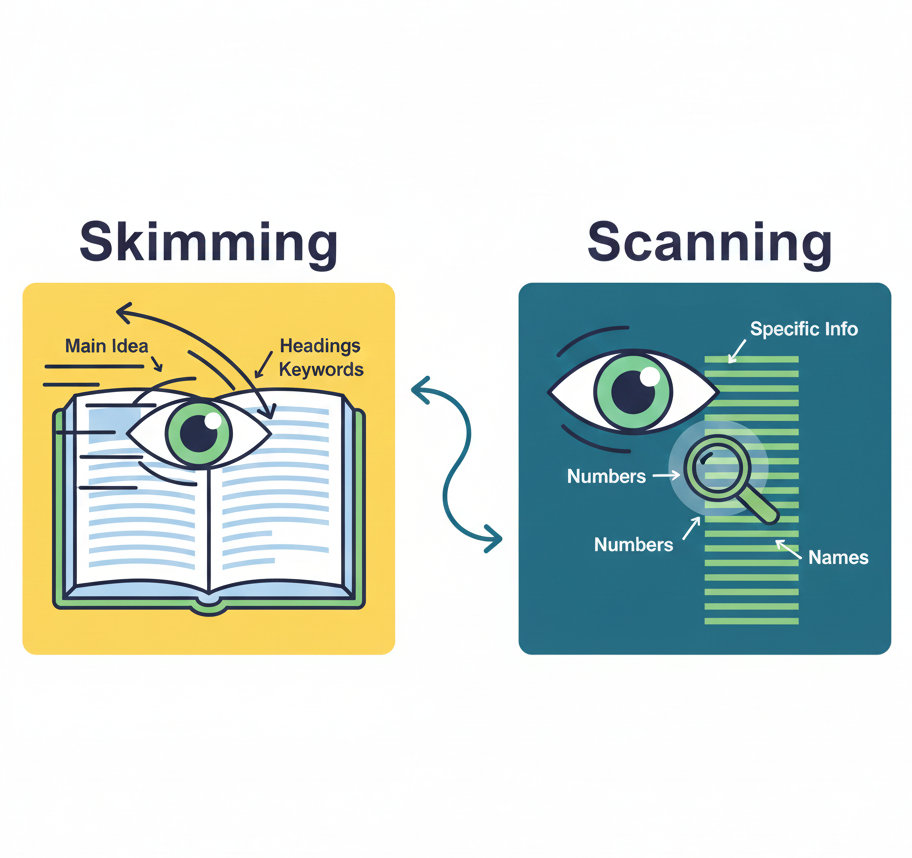
- Skimming is for PURPOSE and STRUCTURE. It’s your bird’s-eye view. You do this first to create a “mental map” of the text. On screen, this prevents you from getting lost in a wall of text you can’t physically touch.
- Scanning is for PRECISE ANSWERS. It’s your laser pointer. Once you have your mental map from skimming, you use scanning to zoom in on the exact location of the answer for a specific question.
The Golden Rule: You should NEVER read every word of the passage in detail on your first go.
Part 2: Skimming – The Art of the 60-Second Map
Goal: To understand the main idea, tone, and structure of the passage in 60-90 seconds.
Your On-Screen Technique: The “S-Shape” Sweep
Don’t read line by line. Instead, let your eyes drift quickly down the screen in a soft “S” pattern, catching the key structural elements.
What to Look For & How to Do It:
- THE TITLE/HEADING: This is your anchor. It tells you the central topic.
- THE FIRST SENTENCE OF EACH PARAGRAPH (The Topic Sentence): This is the single most important skimming technique. Authors typically state the main idea of a paragraph here. Use your cursor to quickly drag down the left side of the screen, reading only these first lines.
- THE LAST SENTENCE OF THE PASSAGE (The Concluding Sentence): This often summarizes the author’s final point or conclusion.
- VISUAL CUES:
- Names, Dates, Numbers: They stand out. Notice them, but don’t process them yet.
- Capitalized Words, Italics, Bold: These indicate key terms or definitions.
- Transition Words: Words like “however,” “in contrast,” “furthermore,” “as a result” signal a shift in argument, which is crucial for understanding structure.
Activity 1: The 60-Second Skim Drill
Instructions: You have 60 seconds to skim the passage below. Then, answer the questions without looking back. The goal is not to get all the details, but to capture the gist.
Passage: The Enigma of Animal Navigation
[A] The ability of animals to navigate across vast and featureless landscapes has baffled scientists for centuries. How do Arctic terns complete a 70,000-kilometer round trip from the Arctic to the Antarctic and back? How do monarch butterflies, over several generations, find their way to a specific cluster of trees in Mexico they have never seen? The answers are gradually being uncovered, revealing a reliance on a complex suite of cues both internal and external.
[B] One of the most well-studied mechanisms is the use of the sun as a compass. Animals like bees and birds can track the sun’s position across the sky. However, this requires an internal circadian clock to compensate for the sun’s movement throughout the day. Without this internal timing mechanism, the sun’s position would be a useless, constantly shifting reference point.
[C] For nocturnal navigators or for travel under overcast skies, a magnetic sense comes into play. Magnetoreception, the ability to detect the Earth’s magnetic field, has been evidenced in species from sea turtles to sparrows. The exact biological mechanism remains debated, with theories ranging from magnetically-sensitive proteins in the eyes to tiny magnetic particles in the beak.
[D] Perhaps the most astonishing finding is the use of olfactory maps. Salmon, returning to their natal stream to spawn, are thought to imprint on the unique chemical signature of the water as smolts. Years later, they follow this scent trail across the ocean. This suggests that for some species, the world is a vast landscape of smells that provides a navigable map.

Part 3: Scanning – The Art of the Laser-Focused Hunt
Goal: To find a specific piece of information (a name, date, word, phrase) as quickly as possible.
Your On-Screen Technique: The “Find” Function & Targeted Eye-Zoom
This is where the computer-based test gives you an advantage.
- USE THE HIGHLIGHT FUNCTION: As you read the questions, highlight the keywords (names, places, unique nouns) in the question itself. This burns them into your brain.
- USE THE “CTRL+F” FUNCTION (The Game-Changer): For specific names, dates, or technical terms, use the Find function. This will instantly show you every occurrence of that word in the text. Warning: Use this for unique keywords only. A word like “problem” will appear too many times to be useful.
- SCAN FOR THE KEYWORD SHAPE: If the word is too common for “Ctrl+F,” scan the passage by moving your eyes rapidly down the text, looking only for the shape of your keyword. Your brain is excellent at pattern recognition. Ignore all other words.
- READ INTENSELY AROUND THE KEYWORD: Once you find it, STOP SCANNING. Read the sentence it appears in, and often the sentence before and after, to find your answer.
Activity 2: The Scanning Sprint
Instructions: Using the same passage on “Animal Navigation,” use scanning techniques to answer the following questions as quickly as you can. Time yourself.
Part 4: Integrated Practice – Putting It All Together
Now, let’s simulate a real test scenario. You will use BOTH skills in sequence.
The Strategy:
- SKIM the passage (60 seconds). Create your mental map.
- READ the questions. Identify the question type and underline/highlight keywords.
- SCAN the passage to locate the answer for each question, using your mental map to know where to start looking.
Integrated Practice Passage: The Rise of Vertical Farming
[A] As the global population continues to urbanize, the challenge of feeding cities without devastating transport costs and environmental damage has prompted a radical solution: vertical farming. This involves growing crops in vertically stacked layers, often in controlled environments like skyscrapers or repurposed warehouses. The primary advantage is the massive reduction in land use, but the benefits extend much further.
[B] One of the most significant claims of vertical farming proponents is its unparalleled water efficiency. Through the use of hydroponic or aeroponic systems, where plant roots are misted with a nutrient-rich solution, these farms can use up to 95% less water than traditional agriculture. This is achieved by recycling virtually all water within the closed system, with minimal loss to evaporation or drainage.
[C] Furthermore, by being located within or on the outskirts of cities, vertical farms slashes the “food miles” associated with produce. A head of lettuce grown in a downtown vertical farm might travel just a few kilometers to a store, compared to hundreds or thousands from a rural field. This not only reduces carbon emissions from transport but also guarantees a level of freshness that is simply unattainable with long supply chains.
[D] Critics, however, point to the substantial energy costs required to power the artificial lighting and climate control systems. While advances in LED technology have made lighting more efficient, the carbon footprint of the electricity used remains a point of contention. The economic viability is also under scrutiny, with high initial setup costs currently limiting the variety of crops that can be grown profitably—primarily leafy greens and herbs.
Questions:
Part 5: Computer-Based Test Specific Pro-Tips
- Practice with a Keyboard: Get used to using
Ctrl+F(orCmd+Fon Mac) instinctively. It’s your best friend for names, dates, and technical terms. - Master the Highlighter: Use it strategically. Highlight keywords in questions. In the text, you could highlight the sentence where you find an answer to easily check later. But don’t over-highlight!
- Split-Screen Familiarity: Get comfortable with the test interface where the passage is on one side and the questions on the other. Practice scrolling smoothly.
- The “Note” Function: Use it sparingly. For a complex paragraph, you could write a 2-3 word note (e.g., “Para C: Criticisms – Energy Cost”) to solidify your mental map.
By deliberately practicing skimming for structure and scanning for details, you will no longer feel overwhelmed by the IELTS reading passages. You will approach them with a clear, efficient, and confident strategy, turning the computer screen from a barrier into your most powerful tool.