
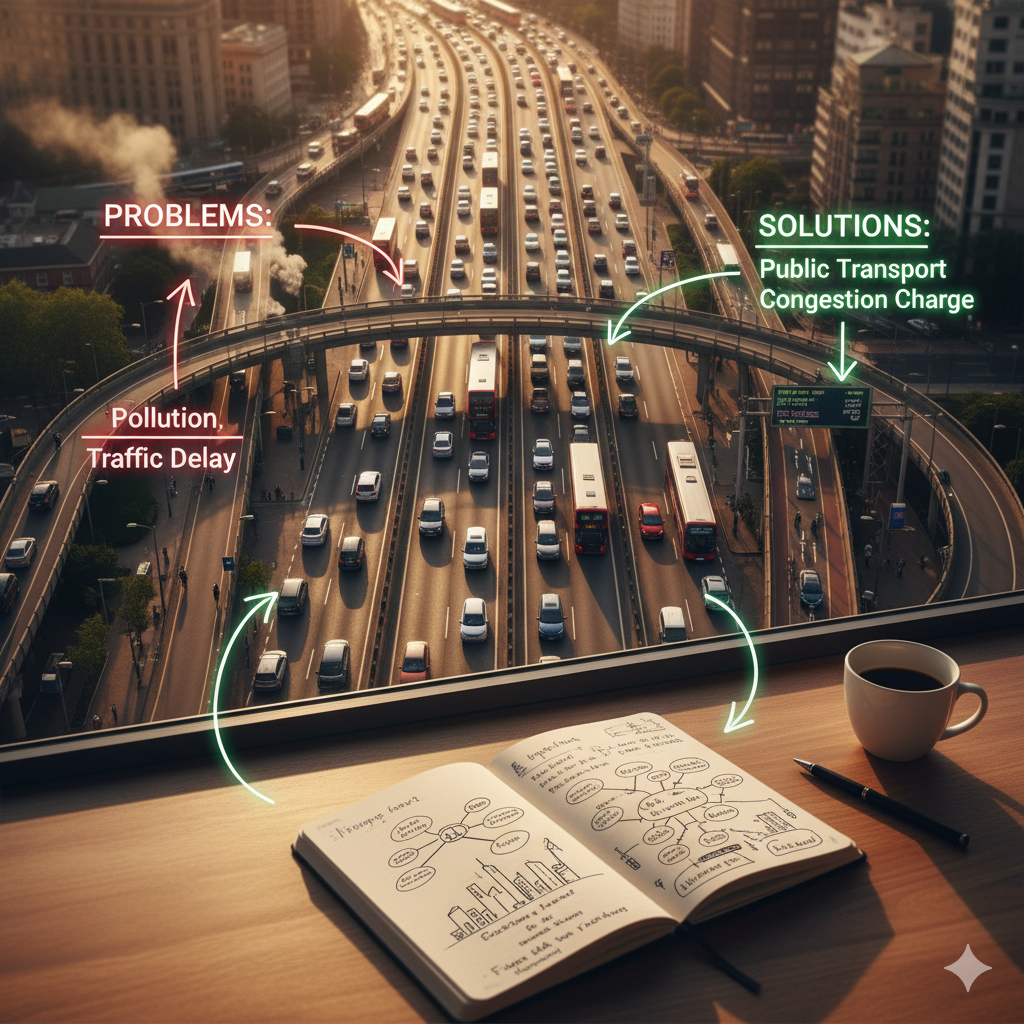
🎯 Question (Problem & Solution)
Many cities face serious traffic congestion. What are the main problems caused by this, and what solutions can be suggested?
🟦 BAND 6 — Full Essay (Simple, functional, limited development)
Introduction
Traffic congestion is a big problem in many cities. It causes many problems and governments should do something about it.
Body Paragraph 1 (Problems)
Traffic causes pollution and wastes people’s time. Cars release smoke and make the air dirty. People also spend hours on the road and this makes them late for work.
Body Paragraph 2 (Solutions)
To reduce traffic, governments can build better public transport and make roads wider. If buses and trains are good, people will not use cars. Also, making roads wider can reduce jams.
Conclusion
In short, traffic has bad effects like pollution and wasting time, but better public transport and bigger roads can be solutions.
Detailed Commentary — Band 6
🔵 [STRUCTURE]
- The essay follows a basic problem–solution structure: Intro → Problems → Solutions → Conclusion. This is the minimum required structure and meets Task Response at a basic level (answers both parts).
- Weak point: Introduction and conclusion are generic and add little beyond repetition.
🟢 [SENTENCE] (sentence-by-sentence role)
- Traffic congestion is a big problem in many cities. — Topic opener (too general).
- It causes many problems and governments should do something about it. — Thesis (vague: “many problems”; “do something” not specific).
Paragraph 1:
- Traffic causes pollution and wastes people’s time. — Topic sentence (lists problems but lacks depth).
- Cars release smoke and make the air dirty. — Simple explanation (repeats “pollution” in plain terms).
- People also spend hours on the road and this makes them late for work. — Example of time lost, but general and unstretched.
Paragraph 2:
- To reduce traffic, governments can build better public transport and make roads wider. — Topic sentence offering two solutions (solution list).
- If buses and trains are good, people will not use cars. — Simple reasoning (conditional but oversimplified).
- Also, making roads wider can reduce jams. — Repetition; “making roads wider” lacks support/evidence.
Conclusion:
- In short, traffic has bad effects like pollution and wasting time, but better public transport and bigger roads can be solutions. — Repeats thesis with near-identical words—no added synthesis.
🟠 [LINKING]
- Connectors are minimal: “also,” “if.” Transitions are mechanical and predictable. Paragraphs are clearly separated but internal cohesion is weak (sentences feel listed, not developed).
🟣 [SUPPORT]
- Examples are generic and not specific (‘cars release smoke’, ‘people spend hours’). No statistics, named studies, or realistic specifics. This limits Task Response depth.
🔴 [WORD CHOICE]
- Vocabulary is everyday and repetitive: big problem, pollution, make the air dirty, wastes time, make roads wider. Limited collocations and register. Lexical range insufficient for bands above 6.
🟤 [GRAMMAR]
- Mostly simple sentences with elementary conditionals; few complex or varied structures. Errors likely minor but not impactful here. Limited grammatical range reduces band.
⚖️ [BAND RATIONALE]
- Task Response: Addresses both problems and solutions but with minimal development — typical Band 6.
- Coherence & Cohesion: Organizationally clear but simplistic and repetitive — Band 6.
- Lexical Resource: Limited range and repetition — Band 6.
- Grammatical Range & Accuracy: Mostly correct but simple — Band 6.
How to improve from Band 6 → 7: Add one specific example or short statistic; expand explanation (why pollution happens, how exactly wider roads may fail); use better transitions and more precise vocabulary.
🟩 BAND 7 — Full Essay (Clear, balanced, more development)
Introduction
Traffic congestion in urban areas has become a severe issue in recent decades. This essay will examine the primary consequences of heavy traffic and propose practical measures, such as improving public transport and implementing congestion charges, to alleviate the problem.
Body Paragraph 1 (Problems)
One major problem caused by traffic congestion is increased air pollution, which harms public health. Vehicles emit pollutants like nitrogen oxides and particulate matter that contribute to respiratory diseases. Additionally, commuting in heavy traffic wastes time and lowers productivity, as workers arrive late or exhausted.
Body Paragraph 2 (Solutions)
Several effective solutions exist. First, governments should invest in reliable and affordable public transport to discourage private car use. Second, policies like congestion charging or limiting car usage during peak hours can reduce traffic volume. For example, cities that have introduced congestion charges have reported a decline in central-city traffic.
Conclusion
In summary, traffic congestion creates environmental and economic problems, but with investment in public transport and sensible traffic management policies, its effects can be significantly reduced.
Detailed Commentary — Band 7
🔵 [STRUCTURE]
- Clear problem–solution organization with a thesis that previews both problems and suggested solutions. This satisfies Task Response more fully than Band 6 by promising specific measures.
- Paragraphing is logical: P1 (problems) develops two linked problems (pollution & productivity); P2 (solutions) gives two solution types and an example.
🟢 [SENTENCE] (roles & mapping)
Introduction:
- Traffic congestion in urban areas has become a severe issue in recent decades. — Paraphrase + hook.
- This essay will examine the primary consequences of heavy traffic and propose practical measures, such as improving public transport and implementing congestion charges, to alleviate the problem. — Thesis: previews both problems and two kinds of solutions (specific).
Body P1:
- One major problem caused by traffic congestion is increased air pollution, which harms public health. — Topic sentence, specific problem + impact.
- Vehicles emit pollutants like nitrogen oxides and particulate matter that contribute to respiratory diseases. — Explanation + nomenclature (shows better lexical resource).
- Additionally, commuting in heavy traffic wastes time and lowers productivity, as workers arrive late or exhausted. — Link to economic impact; provides causal chain.
Body P2:
- Several effective solutions exist. — Topic transition.
- First, governments should invest in reliable and affordable public transport to discourage private car use. — Solution 1 with purpose and reasoning.
- Second, policies like congestion charging or limiting car usage during peak hours can reduce traffic volume. — Solution 2 with examples of policy instruments.
- For example, cities that have introduced congestion charges have reported a decline in central-city traffic. — Concrete example (reference to real policy, even if unnamed — helps Task Response).
Conclusion:
- In summary, traffic congestion creates environmental and economic problems, but with investment in public transport and sensible traffic management policies, its effects can be significantly reduced. — Summary + evaluative tone (positive outlook).
🟠 [LINKING]
- Uses varied connectors: which, additionally, first, second, for example, in summary. These are appropriate and create better cohesion. Paragraph sequencing is logical.
🟣 [SUPPORT]
- Support improved: naming pollutants and linking to health; referencing “cities that have introduced congestion charges” is a short real-world anchor. Still limited — no statistics or named city, but credible.
🔴 [WORD CHOICE]
- More precise vocabulary: nitrogen oxides, particulate matter, respiratory diseases, productivity, congestion charging. Academic register present; collocations used correctly.
🟤 [GRAMMAR]
- Mix of complex sentences (relative clauses, cause–effect structures). Mostly accurate. Sentence variety is better.
⚖️ [BAND RATIONALE]
- Task Response: Fully addresses both parts and suggests realistic solutions — Band 7.
- Coherence & Cohesion: Logical paragraphing and better cohesive devices — Band 7.
- Lexical Resource: Good range and accuracy — Band 7.
- Grammatical Range & Accuracy: Varied structures, controlled — Band 7.
How to improve from Band 7 → 8: Provide a named statistic, deepen explanation of why a solution works (mechanism), add more nuanced linking and slightly broader vocabulary variety (less reliance on common academic phrases).
🟨 BAND 8 — Full Essay (Well-developed, analytical, good range)
Introduction
Traffic congestion is a pressing problem in many metropolitan areas, producing environmental, economic and social costs. This essay discusses the principal problems — notably pollution and productivity losses — and argues that a combination of public transport investment, demand-management policies and urban planning measures can effectively mitigate congestion.
Body Paragraph 1 (Problems)
A primary consequence of severe traffic is deteriorating air quality, which has measurable health and financial repercussions. Emissions from petrol and diesel engines — including fine particulate matter — increase rates of asthma and other chronic conditions, which in turn raise public healthcare expenditure. Moreover, prolonged commuting times erode worker productivity and incur substantial economic costs in lost working hours and increased fuel consumption.
Body Paragraph 2 (Solutions)
To address these issues, authorities should pursue a multi-pronged strategy. Expanding and subsidising reliable public transport encourages commuters to shift from private cars, while demand-management tools such as congestion pricing discourage unnecessary trips during peak periods. Complementary measures, including improved cycling infrastructure and mixed-use urban development, can reduce trip lengths and foster sustainable travel habits. Cities that adopt such integrated approaches tend to see lasting reductions in congestion.
Conclusion
In conclusion, the problems caused by traffic congestion extend beyond inconvenience to significant health and economic harms; however, coordinated policies that combine improved transit, pricing mechanisms and urban redesign offer a practical path to reducing traffic pressure.
Detailed Commentary — Band 8
🔵 [STRUCTURE]
- Thesis explicitly previews problems and a complex, multi-element solution set (public transport + demand management + urban planning). This tight mapping between thesis and body content satisfies Task Response at high level.
- Paragraph 1 analyzes problems with cause→effect→impact chain. Paragraph 2 proposes a well-reasoned strategy with complementary measures and a brief evaluative statement — advanced organization.
🟢 [SENTENCE] (roles & depth)
Introduction:
- Traffic congestion is a pressing problem in many metropolitan areas, producing environmental, economic and social costs. — Paraphrase + complexity (lists cost categories).
- This essay discusses the principal problems — notably pollution and productivity losses — and argues that a combination of public transport investment, demand-management policies and urban planning measures can effectively mitigate congestion. — Sophisticated thesis: identifies problems and an integrated solution approach.
Body P1:
- A primary consequence of severe traffic is deteriorating air quality, which has measurable health and financial repercussions. — Topic sentence with evaluation.
- Emissions from petrol and diesel engines — including fine particulate matter — increase rates of asthma and other chronic conditions, which in turn raise public healthcare expenditure. — Explanatory sentence with technical vocabulary and causal chain.
- Moreover, prolonged commuting times erode worker productivity and incur substantial economic costs in lost working hours and increased fuel consumption. — Extends problem to macroeconomic impact; advanced collocations.
Body P2:
- To address these issues, authorities should pursue a multi-pronged strategy. — Clear signal of solution paragraph.
- Expanding and subsidising reliable public transport encourages commuters to shift from private cars, while demand-management tools such as congestion pricing discourage unnecessary trips during peak periods. — Two linked ideas with reasoning and lexical precision.
- Complementary measures, including improved cycling infrastructure and mixed-use urban development, can reduce trip lengths and foster sustainable travel habits. — Adds depth with urban planning measures and mechanism of effect.
- Cities that adopt such integrated approaches tend to see lasting reductions in congestion. — Evaluative wrap with implied evidence.
🟠 [LINKING]
- Cohesion is natural: notably, which in turn, moreover, while, including, tend to. Linkers are woven into clause structure rather than tacked on.
🟣 [SUPPORT]
- Support is analytic: mechanism (how emissions → health costs) and cross-policy synergy (how urban planning reduces trip length). Still lacks explicit numeric data but uses credible causal explanation and real policy names (congestion pricing).
🔴 [WORD CHOICE]
- Strong lexical range and collocations: deteriorating air quality, fine particulate matter, public healthcare expenditure, multi-pronged strategy, demand-management, mixed-use urban development. Tone is academic and precise.
🟤 [GRAMMAR]
- Uses complex sentence forms (relative clauses, participle phrases, nominalisation). Controlled punctuation (em dash) for emphasis. Very few or no errors expected.
⚖️ [BAND RATIONALE]
- Task Response: Fully addresses both parts with developed explanations and multi-dimension solutions — Band 8.
- Coherence & Cohesion: Logical progression, natural linking — Band 8.
- Lexical Resource: Wide and appropriate vocabulary — Band 8.
- Grammatical Range & Accuracy: Sophisticated structures used accurately — Band 8.
How to improve from Band 8 → 9: Add a short, precise real-world statistic or named case study; slightly more evaluative insight (trade-offs between measures) and even greater lexical subtlety (discursive hedging or more striking academic phrasing).
🟧 BAND 9 — Full Essay (Insightful, fully developed, exemplary cohesion & language)
Introduction
Traffic congestion in contemporary cities imposes substantial environmental, economic and social costs. This essay examines the principal problems stemming from chronic traffic and proposes a set of evidence-based, integrated solutions — including enhanced rapid transit, dynamic pricing and land-use reform — arguing that a strategic blend of these measures is required for sustainable alleviation.
Body Paragraph 1 (Problems)
Chronic congestion degrades air quality and exacts heavy economic tolls. Road transport is a major source of fine particulate matter and nitrogen oxides, which are strongly linked to cardiopulmonary illness; the resultant increase in healthcare demand imposes fiscal pressures on public systems. Simultaneously, time lost in traffic translates into quantifiable economic losses through reduced labour productivity, delayed deliveries and higher operating costs for businesses, thereby undermining urban economic efficiency.
Body Paragraph 2 (Solutions & Justification)
A coherent policy response must combine supply-side improvements with demand-management and spatial planning. Rapid transit investment — for instance, bus rapid transit corridors or metro expansions — provides a high-capacity alternative to private cars, while dynamic pricing (varying tolls by time and location) discourages non-essential trips at peak times. Crucially, integrating transport policy with land-use planning — promoting higher density, mixed-use neighbourhoods — shortens trip distances and embeds sustainable travel behaviour. Evidence from cities that pair pricing with improved transit shows not only reduced vehicle numbers but also better air quality and stronger long-term modal shift.
Conclusion
In conclusion, traffic congestion is more than an inconvenience; it affects public health and economic productivity. Only a strategic, evidence-based combination of improved transit, intelligent pricing and urban planning can deliver durable relief and a healthier, more efficient urban environment.
Detailed Commentary — Band 9
🔵 [STRUCTURE]
- Thesis is sophisticated and narrowly targeted: it not only identifies problems and solutions but signals evidence-based and integrated approach — precise Task Response alignment. The components named in the thesis (rapid transit, dynamic pricing, land-use reform) are each developed in the body, which demonstrates excellent top-down planning.
🟢 [SENTENCE] (micro analysis)
Introduction:
- Traffic congestion in contemporary cities imposes substantial environmental, economic and social costs. — Sharp, academic paraphrase that frames the essay’s stakes.
- This essay examines the principal problems stemming from chronic traffic and proposes a set of evidence-based, integrated solutions — including enhanced rapid transit, dynamic pricing and land-use reform — arguing that a strategic blend of these measures is required for sustainable alleviation. — Thesis: compact, precise, signals both content and evaluative stance (requires integrated response).
Body P1:
- Chronic congestion degrades air quality and exacts heavy economic tolls. — Topic sentence with elevated vocabulary.
- Road transport is a major source of fine particulate matter and nitrogen oxides, which are strongly linked to cardiopulmonary illness; the resultant increase in healthcare demand imposes fiscal pressures on public systems. — Technical causal chain + semicolon use: packs information and shows control.
- Simultaneously, time lost in traffic translates into quantifiable economic losses through reduced labour productivity, delayed deliveries and higher operating costs for businesses, thereby undermining urban economic efficiency. — Further elaboration linking micro effects to macro outcomes (excellent chain of reasoning).
Body P2:
- A coherent policy response must combine supply-side improvements with demand-management and spatial planning. — Topic sentence synthesizing solution types.
- Rapid transit investment — for instance, bus rapid transit corridors or metro expansions — provides a high-capacity alternative to private cars, while dynamic pricing (varying tolls by time and location) discourages non-essential trips at peak times. — Specific examples and parentheses for clarification; balanced comparative structure.
- Crucially, integrating transport policy with land-use planning — promoting higher density, mixed-use neighbourhoods — shortens trip distances and embeds sustainable travel behaviour. — Mechanism explained (how land-use affects travel behaviour).
- Evidence from cities that pair pricing with improved transit shows not only reduced vehicle numbers but also better air quality and stronger long-term modal shift. — Reference to evidence and observed outcomes (shows evaluation and real-world awareness).
Conclusion:
- In conclusion, traffic congestion is more than an inconvenience; it affects public health and economic productivity. — Restates stakes elegantly.
- Only a strategic, evidence-based combination of improved transit, intelligent pricing and urban planning can deliver durable relief and a healthier, more efficient urban environment. — Conclusive evaluative statement with high register; ties back to thesis.
🟠 [LINKING]
- Linkers are embedded structurally: simultaneously, while, thereby, crucially, for instance, not only… but also. They are used to create complex relationships (contrast, cause, exemplification) rather than just sequence.
🟣 [SUPPORT]
- Support is nuanced: mentions mechanisms (how emissions affect health and how urban form shortens trips), includes implied evidence and outcomes from real policy mixes. This kind of support satisfies Task Response at the highest level because it analyses and justifies, not merely lists.
🔴 [WORD CHOICE]
- Wide and precise academic lexicon: chronic congestion, exacts heavy economic tolls, fine particulate matter, cardiopulmonary illness, fiscal pressures, supply-side, demand-management, modal shift, embed sustainable travel behaviour. Collocations and technical terms are used naturally.
🟤 [GRAMMAR]
- Excellent control: varied sentence types, accurate punctuation (semicolons, dashes, parentheses), subordinate clauses and nominalisations. No distracting errors anticipated.
⚖️ [BAND RATIONALE]
- Task Response: Fully and insightfully developed — Band 9.
- Coherence & Cohesion: Logical, integrated, textual cohesion is near-flawless — Band 9.
- Lexical Resource: Wide, precise, academic — Band 9.
- Grammatical Range & Accuracy: Flexible and accurate control of sophisticated grammar — Band 9.
✅ Comparative Summary (What exactly changes across bands)
| Feature | Band 6 | Band 7 | Band 8 | Band 9 |
|---|---|---|---|---|
| Thesis | Vague, general | Clear, previews solutions | Complex, integrated | Precise, evidence-based, scoped |
| Paragraphing | Simple list | Logical separation | Analytical progression | Strategic, multi-element mapping |
| Sentence roles | Basic (topic → statement) | Topic + simple support | Cause→effect chains | Mechanism + evaluation |
| Linking | Basic connectors | Varied connectors | Embedded transitions | Clause-level cohesion |
| Support | Generic examples | Plausible real policies | Mechanisms & implied evidence | Mechanisms + outcomes + evidence |
| Vocabulary | Everyday words | Academic collocations | Technical terms | Wide, precise specialist lexis |
| Grammar | Mostly simple | Mix of simple/complex | Controlled complexity | Sophisticated and accurate |
| Why band fits | Underdeveloped response | Fulfilled task, credible support | Fully developed & coherent | Insightful, evaluative, exemplary |
🔧 Practical Checklist: How to upgrade this exact essay step-by-step
- Thesis: Move from general to scoped + preview. Replace “governments should do something” with exact measures (e.g., “invest in rapid transit, adopt congestion pricing, and reform land use”).
- Paragraph unity: One main idea per paragraph; open with a topic sentence that contains the point and its impact.
- Depth of support: Always explain how a problem causes an effect (mechanism) and why solutions work (mechanism + example). Use 1 short real case or stat if available.
- Linking devices: Prefer clause-level linking (e.g., “which in turn…”, “thereby…”, “while…”) and use them to show causal/contrast relationships.
- Lexical upgrade: Replace general words (bad, big, make) with precise collocations (deteriorate air quality, fine particulate matter, modal shift). Learn 15–20 collocations for urban/transport topics.
- Grammar practice: Master relative clauses, participle phrases, nominalisation, and punctuation for complex sentences. Work on combining short sentences into meaningful complex sentences without losing clarity.
- Tone & register: Keep it formal and academic — avoid contractions and casual phrases.
🧠 Final notes for teachers/students
- Use this post as a micro-model: pick one paragraph from Band 9 and practise writing similar structure on other topics.
- When editing your own essays, mark sentences with the color legend above to check whether each sentence fulfills a function. If you find many “statement-only” sentences (no mechanism, no consequence), push them to add causal explanation or an example.
- Aim for one concrete example per essay (policy name or short statistic) to move comfortably from Band 7 → 8; add evaluation/nuance to reach Band 9.