
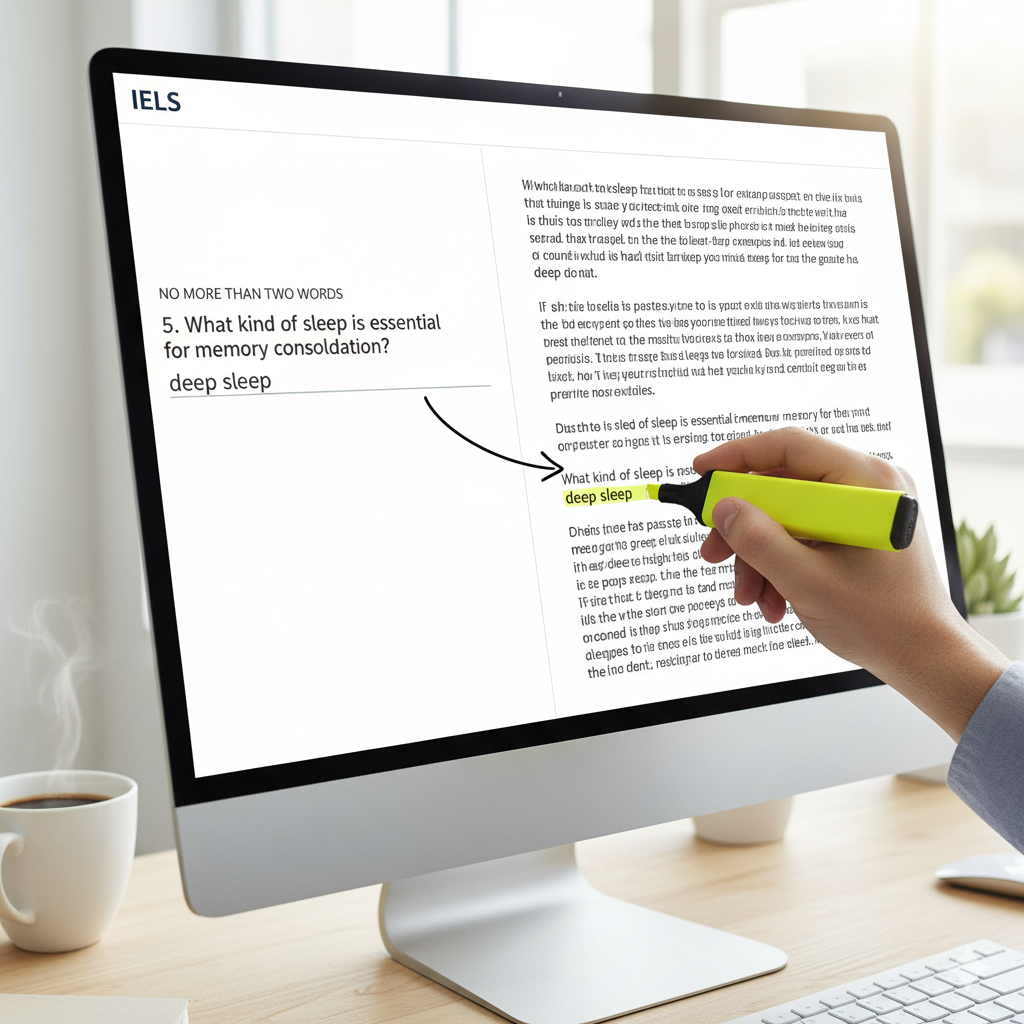
IELTS Short-Answer Questions: The Precision Hunter’s Guide
Short-Answer Questions require you to find a specific piece of information—a name, a number, a reason, a thing—and write it down. It is a pure test of your scanning skills and your attention to detail. Success here is built on one principle: The answer is always in the text, in a single, specific place. Your job is to find it and copy it correctly.
Part 1: Understanding the Task – The “Who, What, Where, When”
You will be asked questions that typically begin with:
- According to the passage,…
- What…
- Who…
- Where…
- When…
- Which…
- Why…
- How…
- How Many…
- How Much…
The instructions will always specify a word limit, such as “Write NO MORE THAN THREE WORDS AND/OR A NUMBER.” This is non-negotiable.
Part 2: The Strategic Blueprint – Locate, Verify, Copy
This is the most straightforward strategy, mirroring the task itself.
Step 1: Deconstruct the Question
- Identify the Question Word (What, Who, When) to know what kind of information you need (a thing, a person, a time).
- Underline the Keywords in the question. These are usually nouns and verbs that are unlikely to be paraphrased (names, places, specific concepts).
Step 2: Scan, Don’t Read
- Take your keywords and scan the passage rapidly. Your eyes should be moving down the text looking for these exact words or their immediate synonyms.
- Ignore everything else. You are on a targeted hunt for a specific quarry.
Step 3: Locate and Verify
- Once you find your keywords, stop scanning. Read the sentence where they appear intensively.
- Check that the sentence actually answers the specific question asked.
- The answer will usually be found in the same sentence as your keywords, or the one immediately before or after.
Step 4: Extract and Copy Precisely
- Identify the exact word or phrase that answers the question.
- Check the word count. If you need to choose a phrase, ensure it does not exceed the limit.
- Copy the word(s) from the text exactly. Do not change the form, tense, or number. Do not add articles (
a,an,the) unless they are part of the essential answer and fit within the word limit.
Part 3: The Examiner’s Toolkit – Precision Traps
The difficulty in this task comes from the examiner’s ability to create “precision traps.”
Trap 1: The Plural/Singular Switch
- Question: “What are the causes of the phenomenon?”
- Text: “The primary cause was found to be…”
- Trick: The question asks for multiple causes, but the text only provides one. The correct answer would be the one cause mentioned, not a plural. You must answer based on the text, not the question’s grammar.
Trap 2: The “Close but Wrong” Distraction
- The keywords from the question will appear in the text, but in a section that does not contain the answer. You must verify the context.
- Question: “What did the 1995 study conclude?”
- Text: “A 1995 study was inconclusive. However, a 1998 study provided the conclusive evidence that traffic congestion was the main issue.”
- Trick: The year “1995” is a distraction. The answer (“traffic congestion”) is linked to the 1998 study.
Trap 3: The Synonym Paraphrase
- The question might use a synonym for a key concept.
- Question: “What was the principal objective of the expedition?”
- Text: “The expedition’s main goal was to map the coastline.”
- Answer:
map the coastline
Trap 4: The Number/Date Requirement
- If a question asks “When…?” or “How many…?”, the answer is almost always a number, date, or age. Scan specifically for numerical digits.
Part 4: Progressive Activities & Exercises
Activity 1: Micro-Skill Builder – The Precision Finder
- Objective: To train your brain to ignore distracting information and extract the exact answer.
Instructions: Read the text snippet and answer the questions using NO MORE THAN TWO WORDS from the text.
Text: “The company, founded in 2001, initially struggled to secure investment. It was the development of their flagship product, the ‘Aura’ lens, in 2005 that finally attracted the attention of major venture capital firms. This investment, totaling $2 million, allowed for mass production.”

Activity 2: Unique Reading Passage & Question Set 1
The Lost City of Trelk
[A] The ancient city of Trelk, long considered a myth by historians, was discovered in a remote valley by a team led by archaeologist Dr. Aris Thorne in 2018. The team’s success was largely due to their use of advanced LIDAR (Light Detection and Ranging) technology, which allowed them to map the terrain through the dense jungle canopy. The initial survey revealed the outlines of massive stone pyramids and a complex network of canals.
[B] Among the most significant early finds was a central plaza containing a stele—a tall, carved stone monument. The inscriptions on this stele, written in a previously unknown script, have proven to be the key to understanding the Trelk civilization. Epigrapher Elena Rostova dedicated three years to deciphering the code. Her breakthrough came when she identified symbols representing the names of rulers and dates of their reigns, correlating them with celestial events.
[C] The deciphered texts revealed that Trelk was a major trading hub that collapsed around 850 AD, not due to war, but because of a prolonged drought that lasted for more than two decades. This finding challenged the previous historical consensus that the region’s cities fell to invasion. The city’s intricate canal system, initially thought to be for transport, was actually a sophisticated response to this water scarcity, designed for irrigation and storing seasonal rainwater.
Questions 1-4
Answer the questions below.
Activity 3: Unique Reading Passage & Question Set 2 (Advanced)
The Science of Memory Consolidation
[A] Memory consolidation is the process by which temporary, fragile memories are transformed into stable, long-term ones. This process is not a simple filing job; it is an active and dynamic reconstruction. The primary brain structure responsible for the initial encoding of experiences is the hippocampus, which acts as a kind of temporary storage site.
[B] Sleep, particularly deep sleep and REM sleep, plays a critical role in strengthening these memories. During these stages, the brain effectively “replays” the day’s experiences, transferring them from the hippocampus to the neocortex for long-term storage. This is why a good night’s sleep after studying is far more beneficial than an all-nighter. Studies have shown that individuals who sleep after learning a new task perform significantly better on recall tests than those who stay awake.
[C] This process can be manipulated. Researchers at the University of Lyon demonstrated that by using targeted sound cues during sleep, they could enhance specific memories. Volunteers learned the locations of objects on a screen, each paired with a unique sound. When these sounds were quietly played again during deep sleep, participants were notably better at remembering the object locations upon waking. This suggests that sleep is not a passive state but an active period of memory curation.
Questions 1-4
Answer the questions below.
Part 5: Final Tips for Test Day Precision
- Order is Sequential: The answers will appear in the text in the same order as the questions.
- Stick to the Word Limit: This is the most common reason for losing marks. If you write three words when the limit is two, your answer is wrong. Hyphenated words count as one word (e.g., “state-of-the-art”).
- Don’t Change the Words: If the text says “scientists,” do not write “researchers,” even if it means the same thing. Copy directly.
- Check Spelling: A misspelled word, especially a name or technical term, is an incorrect answer.
- Numbers are Your Friends: For “How many?” or “When?” questions, scan for digits (1, 2, 3…) or written numbers (one, two, three…).
By adopting this disciplined, hunter-like approach, you turn the Short-Answer task into a points-scoring machine. It rewards speed, accuracy, and a meticulous eye for detail—all skills that are entirely within your control to master.
Explore All The Reading Topics/Questions with their Peculier Strategies & Exercises Here