
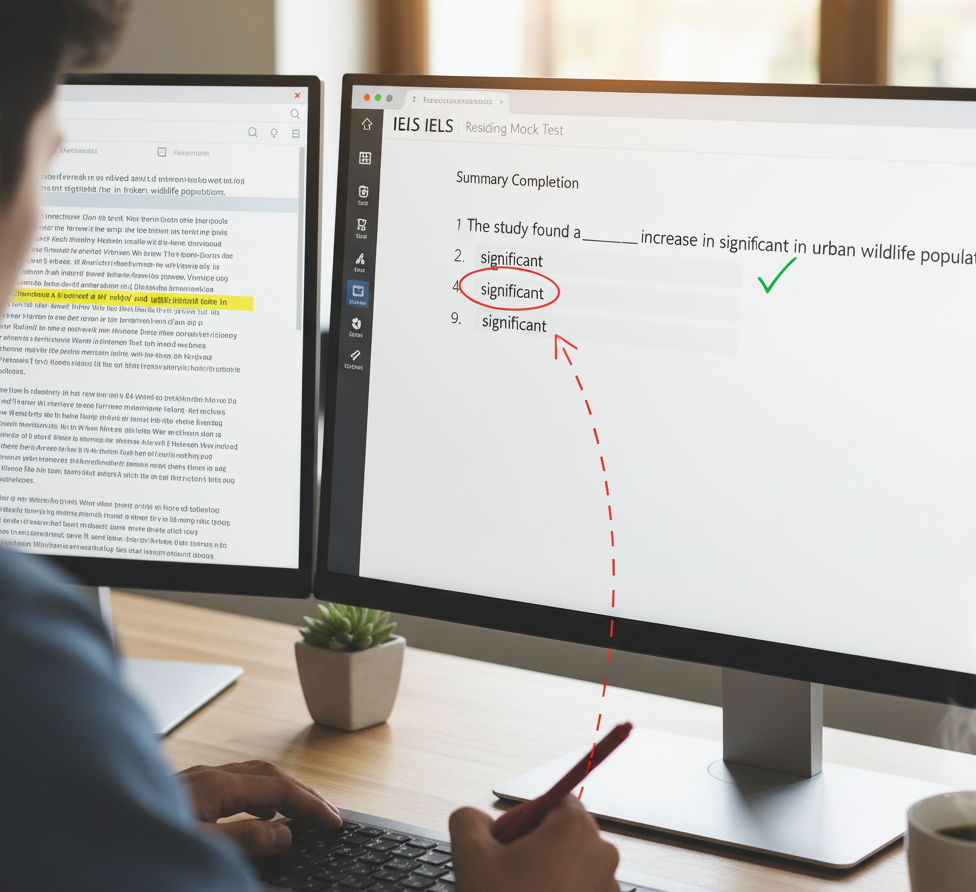
IELTS Summary Completion: The Grammar & Meaning Puzzle Solver’s Guide
The Summary Completion task can feel like a test of both your reading and your grammar skills—because it is. You are given a summary of part of the text with gaps, and you must fill them with words from the passage or from a provided word list. Success here hinges on two skills: precise information location and grammatical logic. This guide will provide you with the system to solve this puzzle every time.
Part 1: Understanding the Two Types
There are two main variations of this task. Your strategy changes slightly for each.
- With a Word List: You are given a box of words to choose from. This is often easier because the correct answer is contained within the list, but it introduces the challenge of synonyms and distractors.
- Without a Word List: You must find the exact word(s) in the passage. This tests your scanning precision and your understanding of the summary’s paraphrase.
Part 2: The Strategic Blueprint – A Two-Stage Process
Your approach must be methodical, combining meaning with grammatical rules.
Stage 1: Analyze the Summary (Before Looking at the Text or Word List)
- Read the Summary for Gist: First, read the entire summary to understand its overall meaning and how it relates to the passage you just read.
- Predict the Answer for Each Gap: For each gap, use the surrounding context to predict:
- Grammatical Form: Is it a noun, verb, adjective, or adverb? Is it singular or plural? Does it need an article (
a,an,the)? - Meaning: Based on the sentences before and after, what kind of word is logically missing? (e.g., a negative effect, a person’s name, a number).
- Grammatical Form: Is it a noun, verb, adjective, or adverb? Is it singular or plural? Does it need an article (
Stage 2: The Targeted Hunt & Selection
- Locate the Relevant Text: Use keywords from the summary sentences (especially proper nouns, dates, or unique phrases) to scan the passage and find the specific section being summarized.
- Find the Exact Match (No Word List): Read that section of the text intensively. Find the word or phrase that is the direct match for your predicted answer. Check that it fits grammatically.
- Eliminate from the Word List (With a Word List):
- Grammar First: Immediately eliminate any words from the list that are the wrong grammatical form for the gap (e.g., eliminate verbs if you need a noun).
- Meaning Second: From the remaining words, see which one is a synonym or direct match for the word or concept in the text.
- Beware of Distractors: The word list will contain synonyms for ideas in the text, but they might be in the wrong context. Ensure the word you choose makes perfect sense in the summary’s sentence.
Part 3: The Examiner’s Toolkit – Grammatical Traps and Meaning Shifts
The examiner’s primary weapons here are grammatical incompatibility and subtle meaning shifts.
Grammatical Traps:
- Plural vs. Singular: The text might say “researchers,” but the summary gap may require a singular noun like “scientist.” The word list will contain both.
- Verb Tense/Form: The summary might be in the present tense (“the study shows…”) while the text uses the past tense (“the study showed…”). The word list will contain both forms.
- Word Family: The text might use “development” (noun), but the summary gap requires an adjective, so “developing” from the word list is correct.
Meaning Shift Traps:
- The “Close Synonym” Distractor: The word list might contain two words that are similar, but only one captures the precise meaning from the text.
- Text says: “The reaction was swift.”
- Word list contains:
quickandimmediate. - Correct choice:
immediateis a closer synonym to “swift” than “quick” in this context.
- The “Out-of-Context” Word: A word from the list appears in the text, but it relates to a different part of the passage and doesn’t fit the summary’s context.
- The “Abstract for Concrete” Swap: The summary might use a general term, while the text uses a specific example. You must make the connection.
- Summary gap: “a period of economic ______.”
- Text says: “the Great Depression.”
- Correct answer:
declineordownturn(the general concept for the specific event).
Part 4: Progressive Activities & Exercises
Activity 1: Micro-Skill Builder – The Grammar & Meaning Predictor
- Objective: To train your brain to predict the grammatical form and meaning of the missing word before seeing the options.

Activity 2: Unique Reading Passage & Question Set 1 (With a Word List)
The Discovery of Penicillin
[A] The discovery of penicillin, one of the world’s first antibiotics, was a classic example of a fortuitous accident. In 1928, the Scottish scientist Alexander Fleming returned to his laboratory after a vacation. He noticed that a culture plate of Staphylococcus bacteria he had left out was contaminated with a mould. What was remarkable was that the bacteria surrounding the mould had been killed.
[B] Fleming identified the mould as belonging to the Penicillium genus. He dedicated the next few years to studying this substance, which he named “penicillin.” He found it was effective against a wide range of bacteria and was non-toxic to humans. However, he struggled to produce it in stable, quantities. Unable to purify it sufficiently for medical use, he eventually set the project aside, and his initial papers garnered little attention.
[C] The baton was picked up over a decade later by a team of scientists at Oxford University, led by Howard Florey and Ernst Chain. They successfully isolated and purified penicillin. Their work, funded by the British and American governments during World War II, demonstrated the drug’s power to treat bacterial infections in humans. Mass production began, saving countless lives on the battlefield and in civilian life.
Questions 1-4
Complete the summary below.
Activity 3: Unique Reading Passage & Question Set 2 (With a Word List)
The Psychology of Procrastination
[A] Procrastination is not simply a matter of poor time management; rather, it is a complex psychological behavior rooted in emotional regulation. When faced with a daunting, unpleasant, or anxiety-inducing task, the brain seeks an immediate escape from the negative feelings associated with it. This escape often comes in the form of a more pleasurable distraction, such as browsing social media or watching television. The short-term relief from anxiety reinforces the procrastination habit.
[B] Certain personality traits are linked to a higher tendency to procrastinate. Individuals who score high in impulsivity are more easily sidetracked by immediate rewards. Similarly, those with perfectionistic fears often procrastinate because they are afraid of failing or producing sub-standard work. The task becomes so intimidating that not starting feels safer than facing potential criticism or disappointment.
[C] Breaking the cycle of procrastination requires strategies that address the underlying emotions. One effective method is “implementation intention,” which involves creating a specific “if-then” plan (e.g., “If it is 2 p.m., then I will work on my essay for 25 minutes”). This reduces the mental effort required to start. Another key is to focus on starting the task in a minimal way, known as the “five-minute rule,” which lowers the initial barrier and often leads to continued engagement.
Questions 1-4
Complete the summary using the list of words, A-I, below.
Part 5: Final Tips for Test Day Precision
- Strictly Follow the Word Limit: If it says “NO MORE THAN TWO WORDS,” using three words will make your answer wrong. Hyphenated words count as one word (e.g., “state-of-the-art”).
- Copy the Words Exactly: Do not change the form of the word you take from the passage. If the text says “development,” do not write “developing” unless it grammatically must change (which is rare).
- Check Spelling: A misspelled word is an incorrect answer.
- The Order is Sequential: The information for the summary will almost always be found in the text in the same order as the gaps.
By mastering this two-stage process of grammatical prediction and precise meaning matching, you turn the summary completion task from a guessing game into a logical, step-by-step procedure. You are no longer just a reader; you are a textual detective and a grammarian, perfectly completing the puzzle.
Explore All Reading Topics/Question Types with their Particular Strategies and Exercises Here