
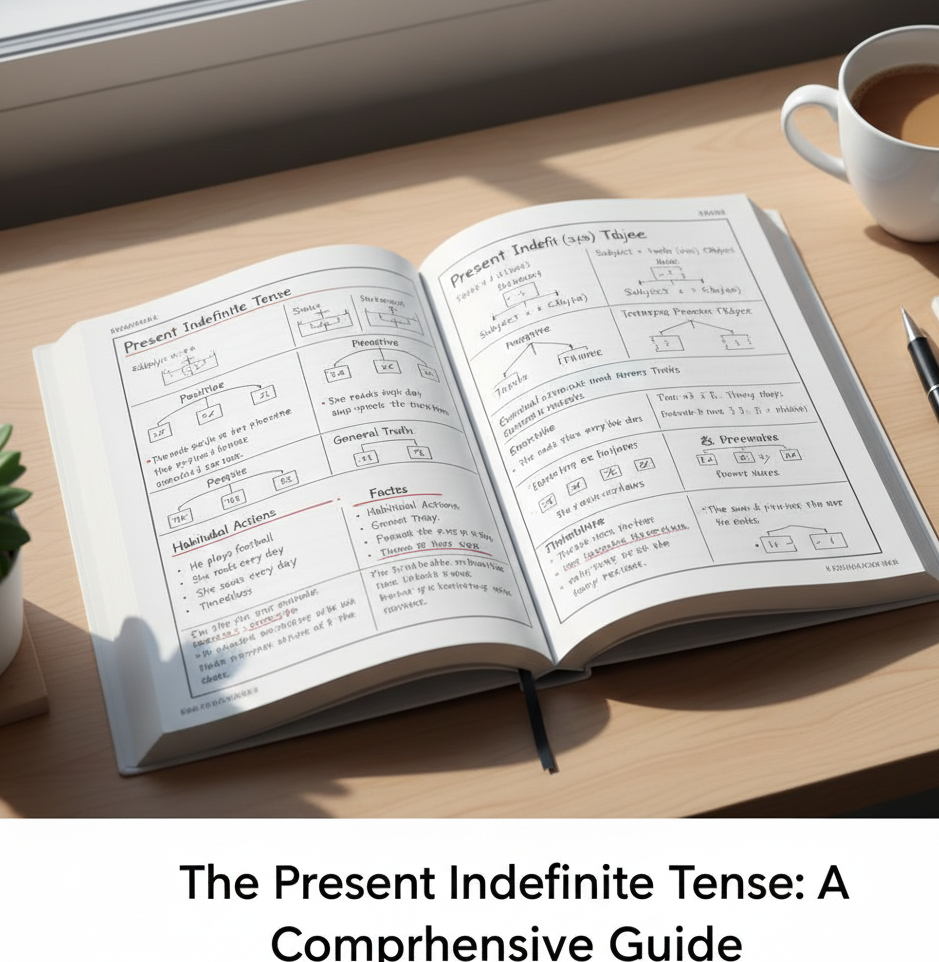
1. Introduction & Importance
The Present Indefinite (or Simple Present) Tense is the foundation of English grammar. It describes general truths, habits, routines, and permanent states. Its importance cannot be overstated—it is the most frequently used tense for expressing facts, daily life, schedules, and universal realities. Mastering it is essential for clear communication in both spoken and written English.
2. Usage
- Habits & Routines: Actions done regularly (e.g., I brush my teeth twice a day.)
- General Truths & Facts: Scientific facts, universal truths (e.g., The sun rises in the east.)
- Permanent States: Feelings, beliefs, possessions, senses (e.g., She loves music.)
- Scheduled Future Events: Timetables, fixed programs (e.g., The train leaves at 9 PM.)
- In Narratives & Demonstrations: Live commentary, storytelling (e.g., He passes the ball to Ronaldo!)
3. Formulas & Structures
There are two main types based on the verb type.
A. State Verb (Using “To Be”)
Used to describe states, identities, qualities, locations, and conditions.
- Formula: Subject + am/is/are + Complement
- “To Be” Forms: I am, He/She/It is, You/We/They are
- What follows the verb? After “am/is/are,” we use:
- Nouns: She is a doctor.
- Adjectives: They are happy.
- Prepositional Phrases (for location): The book is on the table.
- Adverbs of Place/Time: He is here. The meeting is tomorrow.
B. Action Verb (Using Main Verb)
Used to describe actions, habits, and routines.
- Formula: Subject + Base Verb (+s/es for 3rd person singular) + Object/Complement
- 3rd Person Singular Rule: He/She/It → add -s or -es (e.g., He teach__es__, She work__s__)
- What follows the verb? After the main verb, we can have:
- Direct Object (Noun/Pronoun): She reads a book.
- Adverb of Manner/Frequency: He runs quickly. She often travels.
- Infinitive (to + verb): I want to leave.
- Prepositional Phrases: He looks at the sky.
4. How to Identify: State vs. Action
This is a critical distinction.
| Aspect | Use “To Be” (State) | Use Main Verb (Action) |
|---|---|---|
| Question to Ask | “Is this describing what someone/something IS?” | “Is this describing what someone/something DOES?” |
| Nature | Static, unchanging (for now): identity, feeling, location. | Dynamic, active: an activity, process, or routine. |
| Examples | I am tired. This is a cat. We are in London. | I eat lunch. She drives a car. They play football. |
| Key Test | Can you replace the verb with “am/is/are” and it still makes sense? If yes, it’s a state needing “to be.” | Does the verb show a change or activity? If yes, use the main verb. |
⚠️ Watch Out for State Verbs! Some verbs (have, see, hear, know, like, want, belong) are non-action/stative verbs. They describe states, not actions, and are NOT used in continuous tenses (e.g., I am knowing ❌ | I know ✅). In Present Indefinite, treat them like “to be”—they follow the subject directly.
5. Active and Passive Voice in Present Indefinite
Active Voice:
Focus is on the doer of the action.
- Formula: Subject (doer) + Verb (+s/es) + Object (receiver)
- The chef prepares the meal.
- She writes a letter.
Passive Voice:
Focus is on the receiver of the action.
- Formula: Subject (receiver) + am/is/are + Past Participle (V3) + by + Agent (doer – optional)
- The meal is prepared by the chef.
- A letter is written by her.

Final Tip for Mastery: Consistency is key. Practice identifying the core state (is/am/are) vs. action (do/does + verb) in every sentence you read. This fundamental skill will improve your accuracy across all tenses.