
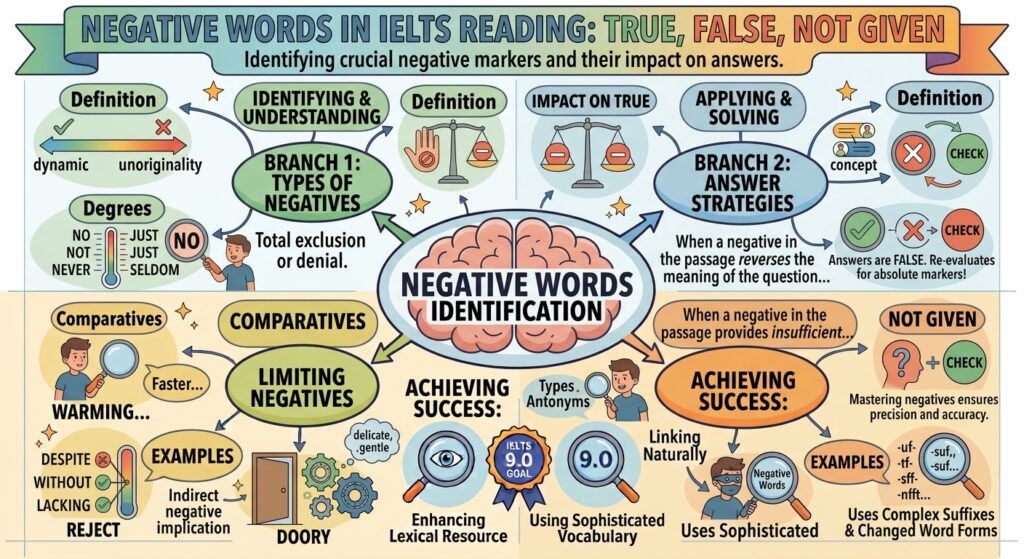
Negative Words in IELTS Reading: True / False / Not Given
IELTS with Mujahid · Beginner practice
Score: 0 / 0Answered: 0 / 0
Why negative words matter: In True / False / Not Given questions, a small word like not, never, hardly or refuse can change the whole answer. Always check the meaning of negative words in both the passage and the statement.
TRUE
The statement has the same meaning as the passage.FALSE
The statement has the opposite meaning.NOT GIVEN
The passage has no information about it.
The statement has the same meaning as the passage.FALSE
The statement has the opposite meaning.NOT GIVEN
The passage has no information about it.
Passage: The library does not open on Sundays.1. The library is closed on Sundays. → TRUE (not open = closed)2. The library opens every Sunday. → FALSE (opposite meaning)3. The library is crowded on Saturdays. → NOT GIVEN (nothing about Saturdays)
Direct negative wordsThese say “no”
Near-negative wordsThey mean “almost none”. Careful: a few and a little are positive.
Negative adjectivesThe meaning is already negative
Negative verbs & phrasesLook for the hidden “not”
Double negativesTwo negatives make a positive idea
💡 IELTS tip: Underline negative words and extreme words (never, always, all, none, only) in the statement. FALSE needs a clear contradiction. If the passage says nothing about the idea, the answer is NOT GIVEN. Few is not the same as none, and rarely is not the same as never. Never use your own knowledge.
Ready? Tap a tab above and start with 1. Word Meaning.
Activity 1: Word Meaning
Choose the meaning of each negative word or phrase.
Activity 2: Double Negatives
Choose what each double negative means.
Activity 3: True / False / Not Given
Read the passage and the statement. Choose True, False or Not Given.
Activity 4: Find the TRUE Statement
Read the passage. Choose the statement that is TRUE. Watch out for extreme words like never and no.
Activity 5: Type It
Read the passage and statement. Type True, False or Not Given. Press Check or Enter.