
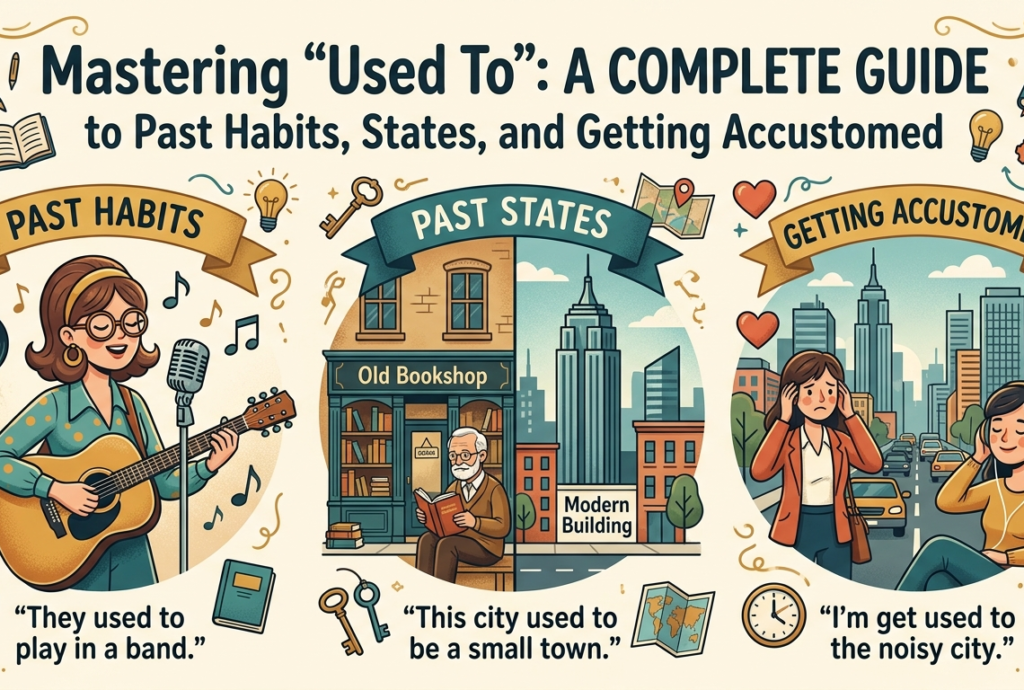
Mastering “Used To”: A Complete Guide to Past Habits, States, and Getting Accustomed
If you’ve ever been confused by sentences like “I used to smoke” versus “I am used to the noise,” you are not alone. The English expression “used to” is a classic challenge for learners because it has three distinct forms, each with a different meaning and grammatical structure.
But fear not! By the end of this comprehensive guide, you’ll understand the difference between:
- Used to (the past habit)
- Be used to (being accustomed)
- Get used to (the process of becoming accustomed)
We’ll cover the grammar, the pronunciation, common mistakes, and provide plenty of examples and exercises to cement your understanding. Let’s dive in.
Part 1: “Used to” – Past Habits and States
This is the most common use of “used to.” We use it to talk about things that happened regularly in the past but no longer happen in the present.
The Meaning
- Past habits: Actions that were repeated in the past.
- Past states: Situations or conditions that were true in the past but are not true now.
The Structure
Positive:
Subject + used to + base verb
- I used to live in London. (I don’t live there now.)
- She used to play the violin. (She doesn’t play it anymore.)
- We used to be best friends. (We aren’t best friends now.)
Negative:
Subject + didn’t use to + base verb
- I didn’t use to like coffee. (Now I do.)
- He didn’t use to exercise. (Now he does.)
Question:
Did + subject + use to + base verb?
- Did you use to have a beard?
- Where did you use to live before you moved here?
⚠️ Common Mistake: The “D” Disappears
When you form a negative or a question with “did,” the verb “use” returns to its base form—without the -d.
- ✅ I didn’t use to like spinach.
- ❌ I didn’t used to like spinach.
Key Rules & Limitations
- You cannot use “used to” for single actions. If it happened only once, use the simple past.
- ✅ I visited Paris last year.
- ❌ I used to visit Paris last year.
- Used to vs. Would: Both can describe past habits, but only “used to” can describe past states (feelings, possession, location).
- ✅ I used to have a motorcycle. (State)
- ❌ I would have a motorcycle. (Incorrect for a state)
Part 2: “Be Used To” – Being Accustomed
This phrase is easily confused with the first one, but it functions very differently. Here, “used to” acts like an adjective meaning “accustomed” or “familiar with.”
The Meaning
It means something is normal for you. It is not strange or difficult anymore. This can be used in any tense.
The Structure
Subject + be + used to + noun / gerund (-ing verb)
- I am used to the cold weather. (noun)
- She is used to waking up early. (-ing verb)
- They were used to the long commute. (past tense)
Negative:
Subject + be + not + used to + noun / gerund
- I am not used to the food here yet.
- He isn’t used to working under pressure.
Question:
Be + subject + used to + noun / gerund?
- Are you used to living alone?
- Was she used to the fast pace of the city?
🧠 Key Concept: “To” is a Preposition
This is the most important grammar rule to remember here. In “be used to,” the word “to” is a preposition, not part of an infinitive. This means the verb that follows must be in the -ing form (gerund).
- ✅ I am used to working late.
- ❌ I am used to work late.
Part 3: “Get Used To” – The Process of Becoming Accustomed
This is the dynamic version of “be used to.” It describes the process of becoming familiar with something, not the state of being familiar.
The Meaning
It means to become accustomed. It often implies a process that takes time.
The Structure
Subject + get + used to + noun / gerund
- I am getting used to the new software. (It’s still a bit difficult, but I’m learning.)
- It took her a year to get used to the humidity.
- You will get used to driving on the left eventually.
You can use “get” in all tenses:
- Past: He got used to the routine quickly.
- Present: I am getting used to my new job.
- Future: You will get used to it.
The Ultimate Comparison
To see the difference clearly, look at how the meaning changes with one subject—the morning:
| Phrase | Meaning | Example |
|---|---|---|
| Used to | A past habit (no longer true). | I used to wake up at noon. (In the past, I woke up at noon. Now I don’t.) |
| Be used to | A state of being accustomed. | I am used to waking up at 6 a.m. (Waking up at 6 a.m. is normal and easy for me.) |
| Get used to | The process of becoming accustomed. | I am getting used to waking up at 6 a.m. (It’s hard, but I’m learning and it’s becoming easier.) |
Pronunciation Tips
In fast, natural English, the pronunciation changes slightly:
- “Used to” (past habit) sounds like “yoosta.” The ‘d’ and ‘t’ blend together.
- I yoosta live here.
- “Be used to” and “get used to” sound like “yoostoo.”
- I’m yoostoo the traffic.
Exercises
Now it’s time to practice. Choose the correct form: used to / be used to / get used to. Answers are at the end.
Exercise 1: Fill in the Blank
- When I was a child, I _____________ (play) outside every day.
- She has lived in Singapore for ten years. She _____________ (the heat).
- I’m finding my new job difficult, but I’m slowly _____________ (work) longer hours.
- _____________ you _____________ (live) in a small town when you were young?
- He _____________ (not / like) spicy food, but now he loves it.
- After moving to the countryside, it took me a while to _____________ (not hear) the sound of traffic.
- Don’t worry about the new system. You _____________ (it) soon.
Exercise 2: Correct the Mistake
Each of these sentences contains one mistake. Find it and correct it.
- I didn’t used to enjoy classical music.
- Are you used to work at night?
- She used to being the manager, but she retired last year.
- I used to go to Paris twice in 2019.
- They will soon be used to live in a colder climate.
Exercise 3: Choose the Correct Meaning
Read the sentence and choose the correct interpretation (A or B).
- I used to drink three cups of coffee a day.
A) I drink three cups of coffee a day now.
B) I don’t drink three cups of coffee a day anymore. - I’m not used to drinking black coffee.
A) I don’t normally drink black coffee; it’s unfamiliar.
B) I never drank black coffee in the past. - It was hard, but I got used to the new schedule.
A) I had a habit of having a new schedule in the past.
B) I became accustomed to the new schedule after some difficulty.