
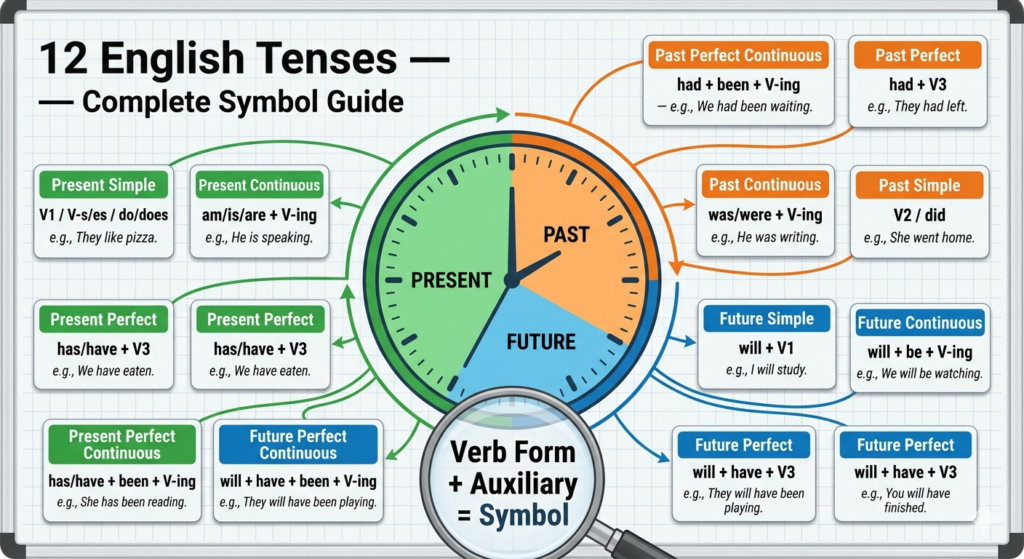
Tenses are the backbone of English communication. Without them, you cannot express when an action happens. But with 12 tenses, confusion is natural. This guide breaks each tense down with symbols, real-life routines, and exercises so you can finally use them automatically.
Every tense has a unique fingerprint — a set of symbols (auxiliaries, verb forms, suffixes) that tell you exactly which tense is being used. Once you learn these symbols, you will never confuse “I eat” with “I am eating” or “I have eaten” again.
Quick Reference: Tense Symbols (Indicators) at a Glance
| Tense | Symbol (Indicator) | Example |
|---|---|---|
| Present Indefinite | V1 / V1 + s/es | She eats |
| Present Continuous | is/am/are + V1+ing | He is eating |
| Present Perfect | has/have + V3 | They have eaten |
| Present Perfect Continuous | has/have + been + V1+ing | I have been eating |
| Past Indefinite | V2 (past form) | She ate |
| Past Continuous | was/were + V1+ing | He was eating |
| Past Perfect | had + V3 | They had eaten |
| Past Perfect Continuous | had + been + V1+ing | I had been eating |
| Future Indefinite | will + V1 | She will eat |
| Future Continuous | will + be + V1+ing | He will be eating |
| Future Perfect | will + have + V3 | They will have eaten |
| Future Perfect Continuous | will + have + been + V1+ing | I will have been eating |
1. PRESENT INDEFINITE (Present Simple)
🔍 Symbols (Indicators)
| Sentence Type | Symbol | Example |
|---|---|---|
| Positive | V1 (for I/You/We/They) and any Plural Subject in the sentence V1 + s/es (for He/She/It) and any other Singular Subject in the sentence | I work. She works. Children play. Ali plays. People walk. Sara walks. |
| Negative | do/does + not + V1 Singular Subject =’does‘ Plural Subject = ‘do’ | They do not play. He does not play. |
| Interrogative | Do/Does + subject + V1? | Do you like it? Does she like it? |
Additional symbols:
- Adverbs of frequency: always, often, usually, sometimes, never, every day, on Sundays
📍 When & Where to Use
- Habits & routines – I wake up at 6 AM.
- Universal truths – The sun rises in the east.
- Fixed schedules – The train leaves at 9 PM.
- State verbs (feelings, thoughts, possession) – I believe you. She owns a car.
📘 Routine Examples (with symbols highlighted)
- I wake up at 6:00 AM every day. (V1)
- She wakes up at 5:30 AM. (V1 + s)
- They do not eat meat. (do + not + V1)
- Does he work on Sundays? (Does + subject + V1)
✅ Exercise 1: Fill in the blanks with verbs given in the brackets and decide to use ‘S/ES’ or leave it without ‘S/ES’

2. PAST INDEFINITE (Past Simple)
🔍 Symbols (Indicators)
| Sentence Type | Symbol | Example |
|---|---|---|
| Positive | V2 (past form) – regular: V1+ed / irregular: unique form | I worked. She went. |
| Negative | did + not + V1 | They did not come. |
| Interrogative | Did + subject + V1? | Did you see him? |
Additional symbols: yesterday, last night, last week, in 2010, ago, then, at that time
📍 When & Where to Use
- Completed actions at a specific past time – I met him yesterday.
- Sequences of past events – He woke up, ate, and left.
- Past habits – She played piano as a child.
📘 Routine Examples
- I woke up late yesterday. (V2 – irregular)
- She did not attend the meeting. (did + not + V1)
- Did you call him back? (Did + subject + V1)
- They visited Rome in 2019. (V1+ed – regular)
3. FUTURE INDEFINITE (Future Simple)
🔍 Symbols (Indicators)
| Sentence Type | Symbol | Example |
|---|---|---|
| Positive | will + V1 | I will come. |
| Negative | will + not (won’t) + V1 | She will not go. |
| Interrogative | Will + subject + V1? | *Will you help? * |
Additional symbols: tomorrow, next week, soon, later, in the future, someday, probably
📍 When & Where to Use
- Predictions – It will rain tomorrow.
- Spontaneous decisions – I’ll answer the phone.
- Promises/offers – I will help you.
- Scheduled future – The store will close at 10 PM.
📘 Routine Examples
- I will call you later. (will + V1)
- She won’t attend the meeting. (will + not + V1)
- Will they arrive on time? (Will + subject + V1)
- We will probably go to the beach. (will + probably + V1)
✅ Exercise 3 (10 questions)
4. PRESENT CONTINUOUS (Present Progressive)
🔍 Symbols (Indicators)
| Sentence Type | Symbol | Example |
|---|---|---|
| Positive | is/am/are + V1+ing (Singular Subject = is) (Plural Subject = are) (I = am) | I am working. She is working. They are working. |
| Negative | is/am/are + not + V1+ing | He is not sleeping. |
| Interrogative | Is/Am/Are + subject + V1+ing? | *Are you coming? * |
Additional symbols: now, right now, at the moment, today, this week, Look! Listen!
📍 When & Where to Use
- Actions happening right now – She is reading a book.
- Temporary situations – I am staying at a hotel this week.
- Future arrangements – We are meeting tomorrow.
- Annoying habits (with always) – He is always losing his keys.
📘 Routine Examples
- I am writing a blog post right now. (am + V1+ing)
- She is not working today. (is + not + V1+ing)
- Are you waiting for the bus? (Are + subject + V1+ing)
- They are moving to a new apartment next week. (are + V1+ing)
✅ Exercise 4 (10 questions)
5. PAST CONTINUOUS
🔍 Symbols (Indicators)
| Sentence Type | Symbol | Example |
|---|---|---|
| Positive | was/were + V1+ing | I was sleeping. They were sleeping. |
| Negative | was/were + not + V1+ing | He was not listening. |
| Interrogative | Was/Were + subject + V1+ing? | *Were you working? * |
Additional symbols: at 5 PM yesterday, at that time, all evening, while, when
📍 When & Where to Use
- Actions in progress at a specific past time – At 8 PM, I was watching TV.
- Interrupted actions – I was sleeping when the phone rang.
- Parallel past actions – While I was cooking, he was cleaning.
📘 Routine Examples
- I was driving home at 6 PM yesterday. (was + V1+ing)
- She was reading when the lights went out. (was + V1+ing)
- What were you doing at midnight? (Were + subject + V1+ing)
- They were not listening during the lecture. (were + not + V1+ing)
✅ Exercise 5 (10 questions)
6. FUTURE CONTINUOUS
🔍 Symbols (Indicators)
| Sentence Type | Symbol | Example |
|---|---|---|
| Positive | will + be + V1+ing | I will be waiting. |
| Negative | will + not + be + V1+ing | She will not be sleeping. |
| Interrogative | Will + subject + be + V1+ing? | *Will you be coming? * |
Additional symbols: at 8 PM tomorrow, this time next week, all day tomorrow, while
📍 When & Where to Use
- Actions in progress at a specific future time – At 8 PM tomorrow, I will be driving.
- Future actions that are expected to happen naturally – I’ll be seeing her at work anyway.
- Polite inquiries about plans – Will you be using the car?
📘 Routine Examples
- This time tomorrow, I will be flying to London. (will + be + V1+ing)
- She will be working from home next week. (will + be + V1+ing)
- Don’t call at 9 PM; we will be having dinner. (will + be + V1+ing)
- Will you be attending the conference? (Will + subject + be + V1+ing)
✅ Exercise 6 (10 questions)
7. PRESENT PERFECT
🔍 Symbols (Indicators)
| Sentence Type | Symbol | Example |
|---|---|---|
| Positive | has/have + V3 (past participle) | She has finished. I have finished. |
| Negative | has/have + not + V3 | They have not arrived. |
| Interrogative | Has/Have + subject + V3? | *Have you seen him? * |
Additional symbols: just, already, yet, ever, never, so far, recently, lately, for, since, today, this week
📍 When & Where to Use
- Life experiences – I have been to Paris.
- Past action with present result – She has lost her keys (so she can’t enter).
- Unfinished time periods – I have called you twice today.
- With ‘for’ and ‘since’ – We have lived here since 2018.
📘 Routine Examples
- I have never eaten sushi. (have + never + V3)
- She has already finished her homework. (has + already + V3)
- Have you ever seen a ghost? (Have + subject + ever + V3)
- We have lived here since 2018. (have + V3)
✅ Exercise 7 (10 questions)
8. PAST PERFECT
🔍 Symbols (Indicators)
| Sentence Type | Symbol | Example |
|---|---|---|
| Positive | had + V3 | She had finished. |
| Negative | had + not + V3 | They had not eaten. |
| Interrogative | Had + subject + V3? | Had you seen him before? |
Additional symbols: already, just, never, by the time, before, after, until then
📍 When & Where to Use
- The earlier past action before another past action – I had eaten before they arrived.
- Cause in the past – He failed because he hadn’t studied.
- With ‘by the time’, ‘after’, ‘before’ – By the time we reached, the train had left.
📘 Routine Examples
- I had already finished work when she called. (had + already + V3)
- She had never seen snow before moving to Canada. (had + never + V3)
- Had you met him before the party? (Had + subject + V3)
- They had not eaten all day. (had + not + V3)
✅ Exercise 8 (10 questions)
9. FUTURE PERFECT
🔍 Symbols (Indicators)
| Sentence Type | Symbol | Example |
|---|---|---|
| Positive | will + have + V3 | I will have finished. |
| Negative | will + not + have + V3 | She will not have arrived. |
| Interrogative | Will + subject + have + V3? | *Will they have left? * |
Additional symbols: by (then), by the time, before (future event), by next week, by 2026
📍 When & Where to Use
- Actions completed before a specific future time – By 6 PM, I will have finished work.
- One future event before another – She will have left before you arrive.
📘 Routine Examples
- *By next year, I will have graduated. * (will + have + V3)
- She will have finished the report by Friday. (will + have + V3)
- Will you have eaten before the party? (Will + subject + have + V3)
- They won’t have arrived by 8 PM. (will + not + have + V3)
✅ Exercise 9 (10 questions)
10. PRESENT PERFECT CONTINUOUS
🔍 Symbols (Indicators)
| Sentence Type | Symbol | Example |
|---|---|---|
| Positive | has/have + been + V1+ing | I have been waiting. She has been waiting. |
| Negative | has/have + not + been + V1+ing | They have not been sleeping. |
| Interrogative | Has/Have + subject + been + V1+ing? | *Have you been working? * |
Additional symbols: for, since, all day, all morning, lately, recently, how long
📍 When & Where to Use
- Actions that started in the past and continue to now – I have been studying for 3 hours.
- Recently stopped actions with visible results – She is tired because she has been running.
- Emphasis on duration – How long have you been waiting?
📘 Routine Examples
- I have been studying English for 5 years. (have + been + V1+ing)
- She has been working here since 2020. (has + been + V1+ing)
- How long have you been waiting? (Have + subject + been + V1+ing)
- They have not been sleeping well lately. (have + not + been + V1+ing)
✅ Exercise 10 (10 questions)
11. PAST PERFECT CONTINUOUS
🔍 Symbols (Indicators)
| Sentence Type | Symbol | Example |
|---|---|---|
| Positive | had + been + V1+ing | I had been waiting. |
| Negative | had + not + been + V1+ing | She had not been sleeping. |
| Interrogative | Had + subject + been + V1+ing? | *Had you been working? * |
Additional symbols: for, since, before, by the time, all day, all morning
📍 When & Where to Use
- Duration before another past action – I had been waiting for an hour when the bus came.
- Cause in the past – He was tired because he had been working all day.
📘 Routine Examples
- She had been studying for three hours before the exam. (had + been + V1+ing)
- They had been dating for two years when they got engaged. (had + been + V1+ing)
- How long had you been waiting? (Had + subject + been + V1+ing)
- His eyes were red because he had been crying. (had + been + V1+ing)
✅ Exercise 11 (10 questions)
12. FUTURE PERFECT CONTINUOUS
🔍 Symbols (Indicators)
| Sentence Type | Symbol | Example |
|---|---|---|
| Positive | will + have + been + V1+ing | I will have been waiting. |
| Negative | will + not + have + been + V1+ing | She will not have been sleeping. |
| Interrogative | Will + subject + have + been + V1+ing? | *Will you have been working? * |
Additional symbols: by (time) + for, for (duration) by then, all day by (time)
📍 When & Where to Use
- Duration up to a future point – By December, I will have been working here for 10 years.
- Cause of a future situation – She will be tired because she will have been traveling all day.
📘 Routine Examples
- By 2028, I will have been teaching for 20 years. (will + have + been + V1+ing)
- Next month, she will have been living in London for 5 years. (will + have + been + V1+ing)
- How long will you have been studying by the exam? (Will + subject + have + been + V1+ing)
- They will have been dating for two years in June. (will + have + been + V1+ing)
✅ Exercise 12 (10 questions)
Final Mastery Challenge (Mixed Tenses – Identify the Symbol First)
For each sentence, write the tense and the symbol (indicator) that helped you decide.
| # | Sentence | Tense | Symbol (Indicator) |
|---|---|---|---|
| 1 | She has been working here since 2015. | Present Perfect Continuous | has + been + V1+ing |
| 2 | At 9 PM yesterday, I was watching a movie. | Past Continuous | was + V1+ing |
| 3 | By next week, they will have finished the project. | Future Perfect | will + have + V3 |
| 4 | Water boils at 100°C. | Present Indefinite | V1 + s |
| 5 | I have never seen such a beautiful place before today. | Present Perfect | have + never + V3 |
| 6 | He was driving when the accident happened. | Past Continuous | was + V1+ing |
| 7 | They had already eaten when we arrived. | Past Perfect | had + already + V3 |
| 8 | Tomorrow at 6 PM, we will be flying to Paris. | Future Continuous | will + be + V1+ing |
| 9 | She has been crying all morning, so her eyes are red. | Present Perfect Continuous | has + been + V1+ing |
| 10 | I promise I will not do that again. | Future Indefinite | will + not + V1 |
📌 Quick Symbol Cheat Sheet (Print This!)
| Tense | Positive Symbol | Negative Symbol | Question Symbol |
|---|---|---|---|
| Present Indefinite | V1 / V1+s/es | do/does + not + V1 | Do/Does + subject + V1? |
| Present Continuous | is/am/are + V1+ing | is/am/are + not + V1+ing | Is/Am/Are + subject + V1+ing? |
| Present Perfect | has/have + V3 | has/have + not + V3 | Has/Have + subject + V3? |
| Present Perfect Continuous | has/have + been + V1+ing | has/have + not + been + V1+ing | Has/Have + subject + been + V1+ing? |
| Past Indefinite | V2 | did + not + V1 | Did + subject + V1? |
| Past Continuous | was/were + V1+ing | was/were + not + V1+ing | Was/Were + subject + V1+ing? |
| Past Perfect | had + V3 | had + not + V3 | Had + subject + V3? |
| Past Perfect Continuous | had + been + V1+ing | had + not + been + V1+ing | Had + subject + been + V1+ing? |
| Future Indefinite | will + V1 | will + not + V1 | Will + subject + V1? |
| Future Continuous | will + be + V1+ing | will + not + be + V1+ing | Will + subject + be + V1+ing? |
| Future Perfect | will + have + V3 | will + not + have + V3 | Will + subject + have + V3? |
| Future Perfect Continuous | will + have + been + V1+ing | will + not + have + been + V1+ing | Will + subject + have + been + V1+ing? |
🎯 Final Tips for Recognizing Tense Symbols
- Look at the verb first – Is it V1, V2, V3, or V1+ing?
- Look for auxiliaries – do/does, is/am/are, has/have, had, will, was/were, been
- Check for negatives – not after the auxiliary
- Check for question order – auxiliary before subject
- Look for time markers – yesterday, now, by next week, since, for – but remember: time markers help, but the verb structure is the real symbol.
Mastered the symbols? Then you’ve mastered the tenses. Practice identifying the symbol in every English sentence you read. Within weeks, recognition will become automatic.