
Look at the paragraph below and do three things,
- Scan the text and underline all proper nouns (those with capital letters) and numbers.
- Read the first and last sentences of the paragraph. Now, minimize the screen.
- Write one or two sentences explaining what the paragraph is about.
Tea Trade
When America eventually won its independence from British rule in 1783, it began its own free and independent tea trade with China. The success of this trade made some people in Britain question the wisdom of the East India Company’s ongoing monopoly on British trade with the East. In 1813, the Company lost its monopoly on trade with India, but still had a complete monopoly on trade with China, which meant it was heavily dependent on the tea trade. The Company’s charter was due for renewal in 1834, and in the decades before that there was a growing call for the abolition of the monopoly and the instigation of free trade with China as well. Supporters of free trade argued strongly that the Company kept tea prices artificially high in order to maximise its profits, using tactics which included restricting the supply of tea. One anonymous pamphleteer, writing in 1824, stated that ‘the lordly grocers of Leadenhall Street [where the Company was based] have most scandalously abused the monopoly of which they are now in possession.’ Comparing the prices of tea sold at auction in London with the prices at auction in Hamburg and New York, he thundered that ‘the monopoly of the tea trade enjoyed by the East India Company costs the people of this country, on average, not less than two million, two hundred thousand pounds sterling a year!’
World’s oldest leather shoe found in Armenia
Look at the paragraph below and do three things,
- Scan the text and underline all proper nouns (those with capital letters) and numbers.
- Read the first and last sentences of each paragraph. Now, minimize the screen.
- Write one or two sentences explaining what the paragraph is about.
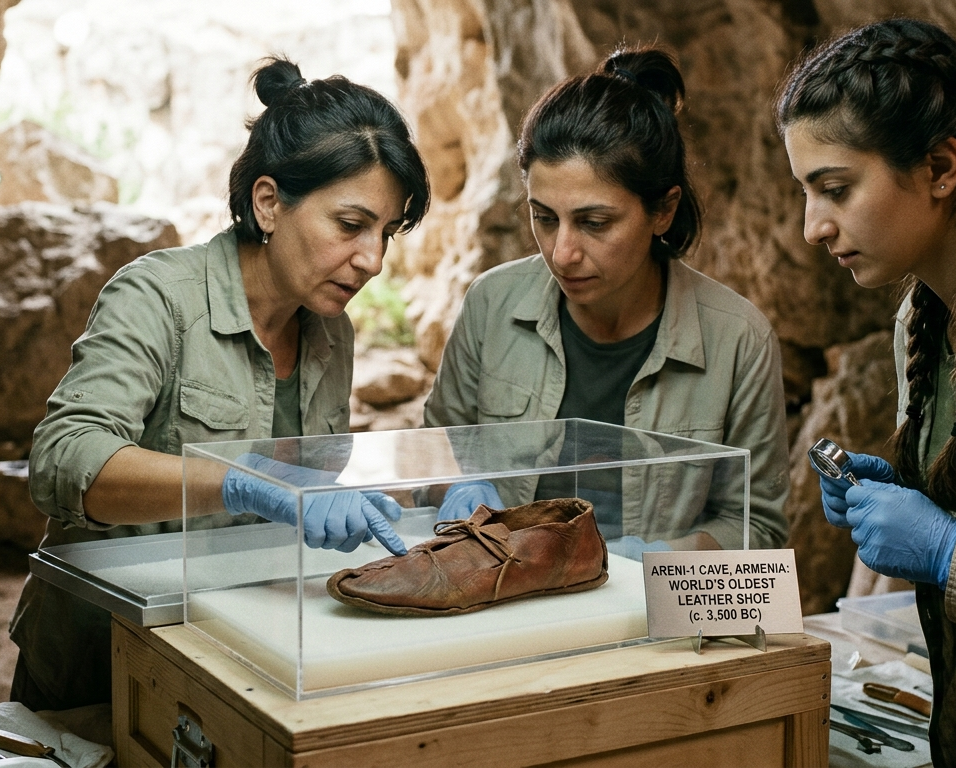
A perfectly preserved shoe, 1000 years older than the Great Pyramid of Giza in Egypt and 400 years older than Stonehenge in the UK, has been found in a cave in Armenia. The 5,500 year old shoe, the olderst leader shoe in the world, was discovered by a team of international archaeologists.
The cow-hide shoe dates back to 3500 BC (the Chalcolithic period) and is in perfect condition. It was made of a single piece of leather and was shaped to fit the wearer’s foot. it containied grass; although the archaeologists were uncertain as to whether this was to keep the foot warm or to maintain the shape of the shoe, a precursor to the modern shoe-tree perhaps? ‘It is not known whether the shoe belonged to a man or woman,” sad lead author of the research, Dr Ron Pinhasi, University College Cork, Ireland “as, while small, (European size 37; US size 7 wome), the shoe could well have fitted a man from that era.” The cave is situated in the Vayotz Dzor province of Armenia, on the Armenian, Iranian, Nakhichevanian and Turkis borders, and was known to regional archaeologists due to its visibility from the highway below.
The stable, cool and dry conditions in the cave resulted in exceptional preservation of the various objects that were found, which included large containers, many of which held well-preserved wheat and barley, apricots and other edible plants. The preservation was also helpted by the fact that the floor of the cave was covered by a thick layer of sheep dung which acted as a solid seal over the objects, preserving them beautifully over the millennia!
“We thought initially that the shoe and other objects were about 600-700 years old because they were in such good condition,” said Dr Pinhasi. “It was only when the material was dated by the two radiocarbon laboratories in Oxford, UK and in California, US that we realised that the shoe was older by a few hundred years than the shoe worn by Orzi, the Iceman.”
Three samples were taken in order to determine the absolute age of the shoe and all three tests produced the same results. The archaeologists cut two small strips of leather off the shoe and sent one strip to the Oxford Radiocarbon Accelerator Mass Spectrometry Facility. A piece of grass from the shoe was also sent to Oxford to be dated and both shoe and grass were shown to be the same age.
The shoe was discovered by Armenian PhD student, Ms Diana Zardaryan, of the Institute of Archaeology, Armenia, in a pit that also included a broken pot and wild goat horns. “I was amazed to find that even the shoe-laces were preserved,” she recalled. “We couldn’t believe the discovery,” said Dr Gregory Areshian, Costen Institute of Archaeology at UCLA, US, co-director who was at the site with Mr. Botis Gasparyan, co-director, Institute of Archaeology, Armenia when the shoe was found. “The crusts had sealed the artefacts and archaeological deposits and artefacts remained fresh dried, just like they were put in a can,” he said.
The oldest known footwear in the world, to the present time, are sandals made of plant materia, that were found in a cave in the Arnold Research Cave in Missouri in the US. Other contemporaneous sandales were found in the Cave of the Warrior, Judean Desert, Israel, but these were not directly dated, so that their age is based on various other associated artefacts found in the cave.
Interestingly, the shoe is very similar to the ‘pampooties’ worn on the Aran Islands (in the West of Ireland) up to the 1950s. “In fact, enormous similarities exist between the manufacturing technique and style of this shoe and those found across Europe at later periods, suggesting that this type of shoe was worn for thousands of years across a large and environmentally diverse region,” said Dr Pinhasi.
“We do not know yet what the shoe or other objects were doing in the cave or what the purpose of the cave was,” said Dr Pinhasi. “We know that there are children’s graves at the back of the cave but so little is known about this period that we cannot say with any certainty why all these different objects were found together.” The team will continue to excavate the many chambers of the cave.
Questions 1-8
Answer the questions below.
Choose NO MORE THAN THREE WORDS AND/OR A NUMBER from the passage for each answer.